1 Executive Summary
The Opportunity
Champions Sports Grounds is a community-first, tournament-enabled sports and hospitality destination proposed for the Cowichan Valley, British Columbia. It is regional infrastructure, not a standalone commercial venue: a place where local families train, gather, and compete on weekdays, and where Island and regional tournaments bring visitors, room nights, and off-season spending on weekends. The concept rests on four reinforcing foundations, in deliberate order: local community use, sports tourism, integrated hospitality, and community impact delivered through a nonprofit Champions Fund that subsidizes access for children, families, and individuals who might otherwise be excluded because of cost.
The project sits inside a larger frame. Within the Cowichan Valley SEE Impact Initiative (CVSEEII), Champions Sports Grounds is Catalyst Two, addressing sports, community wellness, and sports tourism. The initiative's master framing evaluates the concept as the Cowichan Valley Champions Complex, a regional wellness and gathering node rather than simply a sports facility, and the CVSEEII framework sets the evaluation standard this plan adopts: the key question is not whether the region can build a facility, but what kind of facility would create the greatest regional benefit.[source: CVSEEII framework] The Green Nation Collective SEE evaluation scored the concept 80 out of 100 for impact potential and 82 out of 100 for ecosystem opportunity; both are preliminary pre-feasibility scores to be re-scored as evidence matures.[source: GNC SEE evaluation]
The Regional Need
The timing argument is regional, and it is specific. A region of 89,013 residents at the 2021 Census, growing toward roughly 96,000 today, sits at the centre of a corridor holding approximately 513,000 more people in the adjacent Victoria and Nanaimo census metropolitan areas.[source: Statistics Canada, 2021 Census Profiles] A $1.446 billion hospital opens in 2027 as the region's dominant demand and workforce anchor.[source: Island Health, Cowichan District Hospital Replacement Project] The regional district discontinued its dedicated economic development function effective February 20, 2026.[source: cvrd.ca; Cowichan Valley Citizen, Feb 10, 2026] The region has momentum and a coordination gap at the same time. Champions Sports Grounds is designed to serve the first and help answer the second.
The need is documented in the region's own planning work. The CVRD's Regional Recreation Strategic Plan inventories the region's recreation assets and lists no dedicated multi-court gymnasium or fieldhouse, names pickleball as an emerging demand pressure, and records that 26 percent of surveyed residents cite program cost as a barrier to participation.[source: CVRD Regional Recreation Strategic Plan, Final Draft for Public Review, Sept 2025] The region's largest indoor spectator venue was built in 1978. An older-skewing population and below-median household incomes are not weaknesses to argue around; they are the design brief for daytime wellness programming and for the Champions Fund.
The Vision
A gathering place where the Cowichan Valley plays, competes, heals, and celebrates together: where a child in Duncan, a masters athlete in Ladysmith, a visiting team from Victoria, and a family that could not otherwise afford registration fees all walk through the same doors. Community access is a designed outcome with a protected floor of hours, not a residual of commercial scheduling. The full vision, mission, and binding development principles follow in Section 2.
The Program
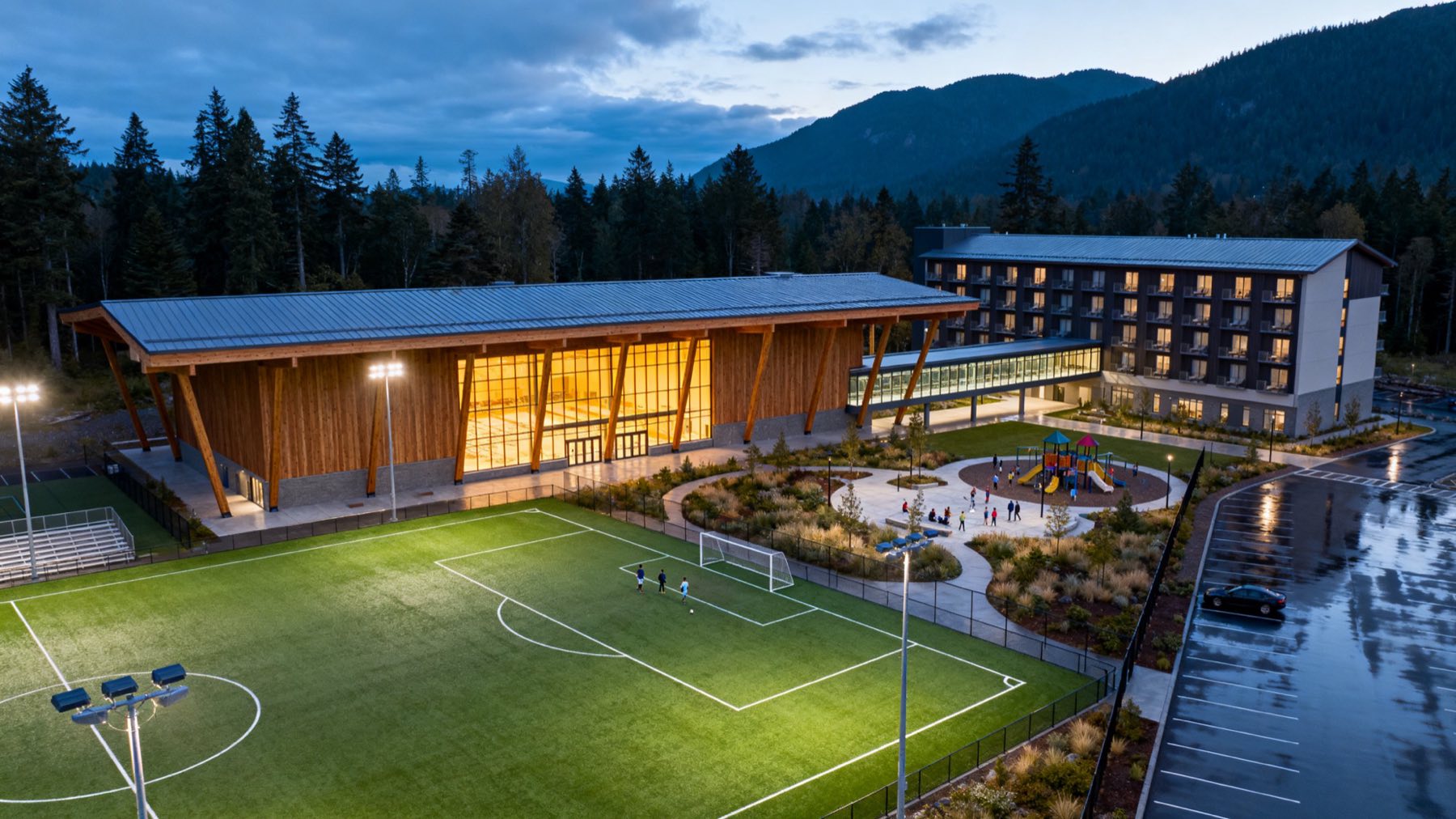
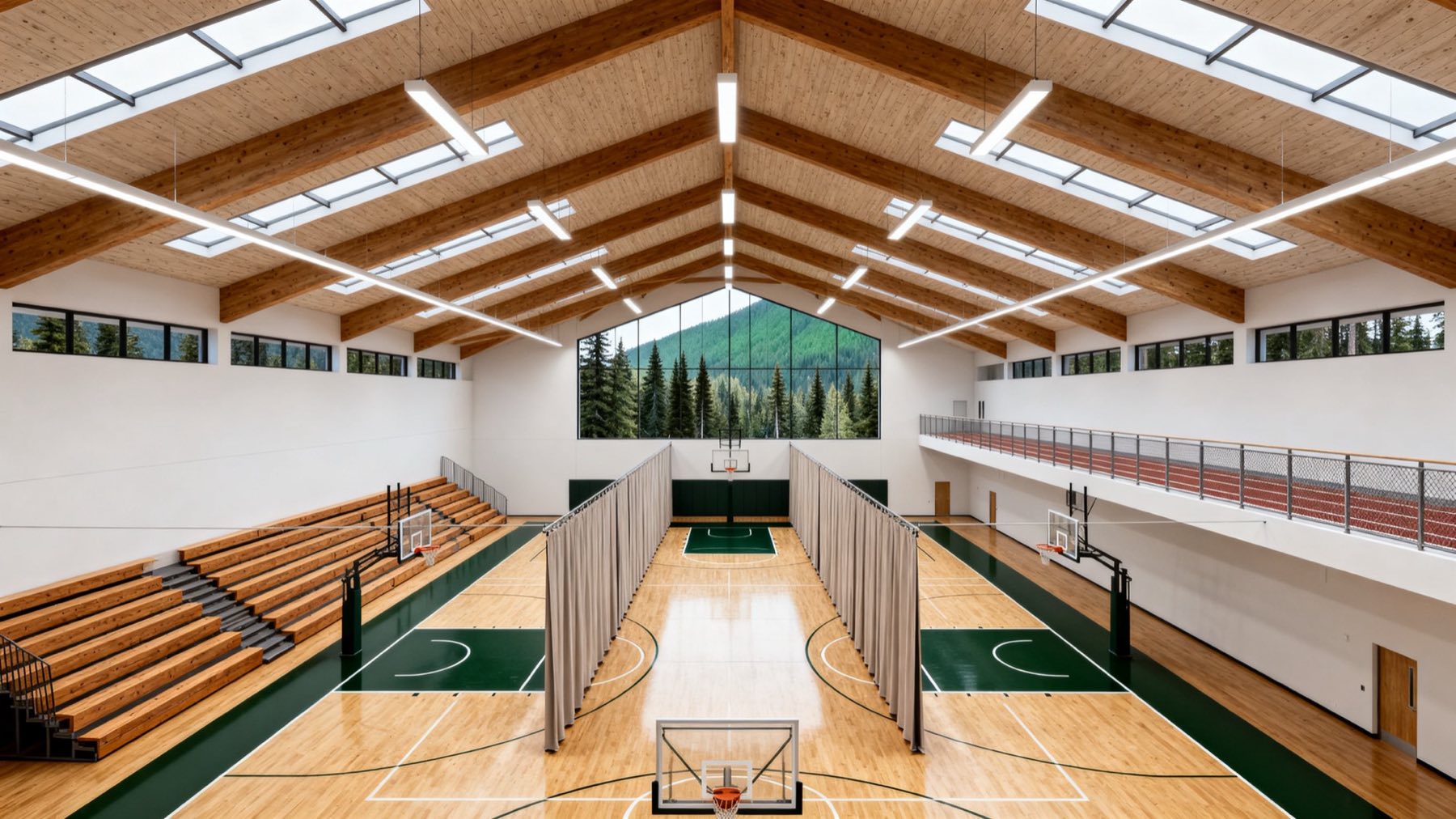
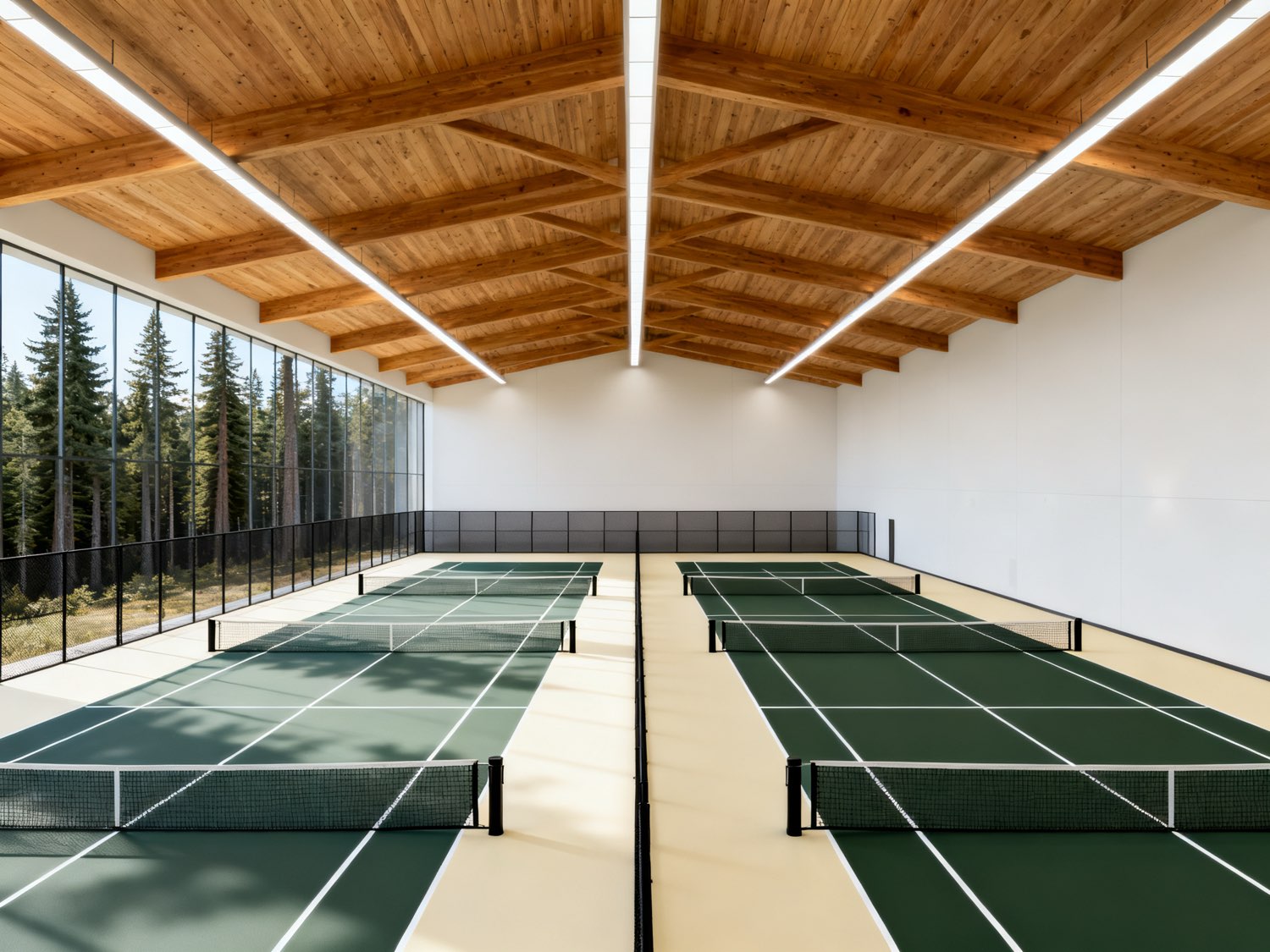
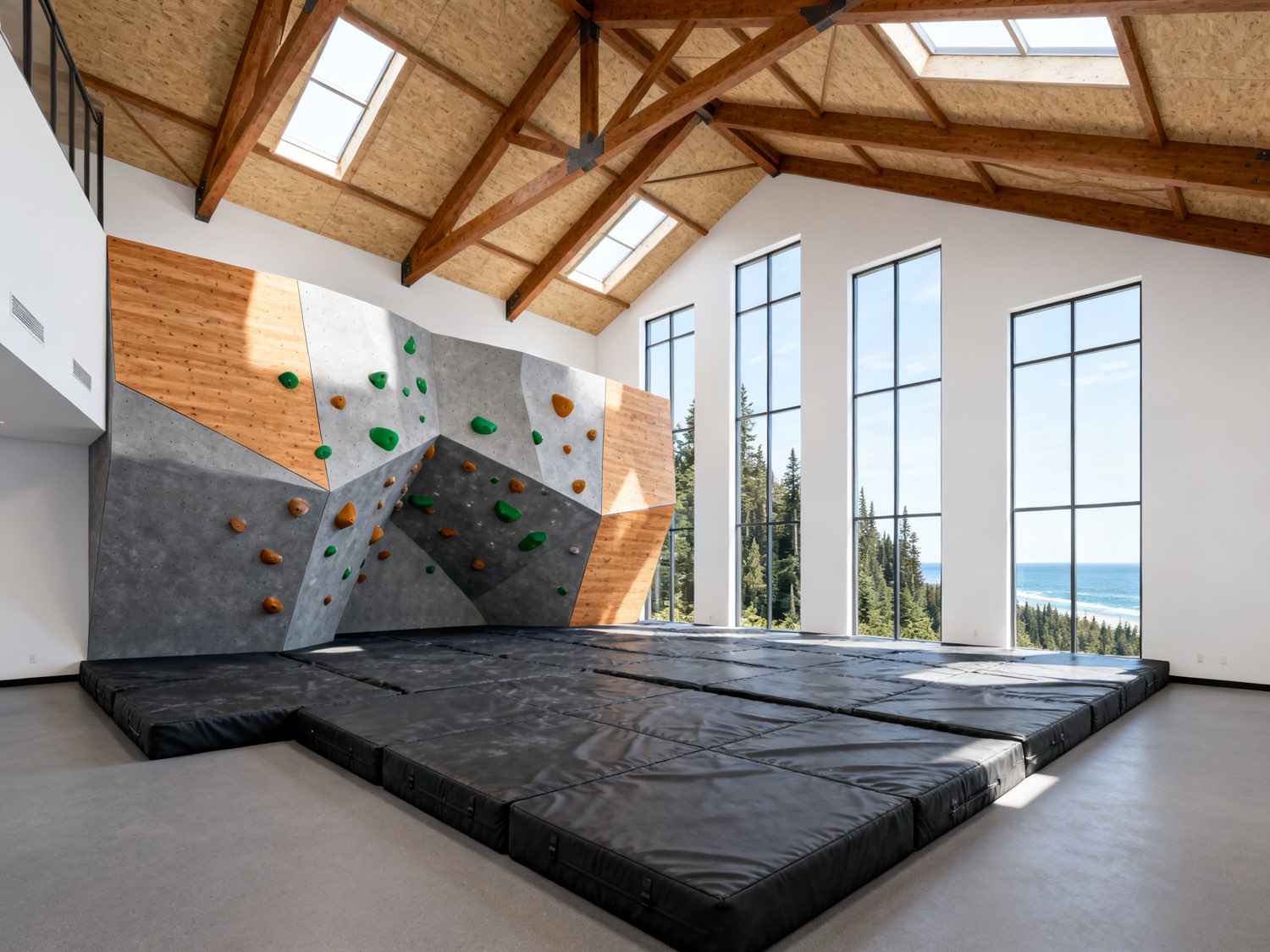
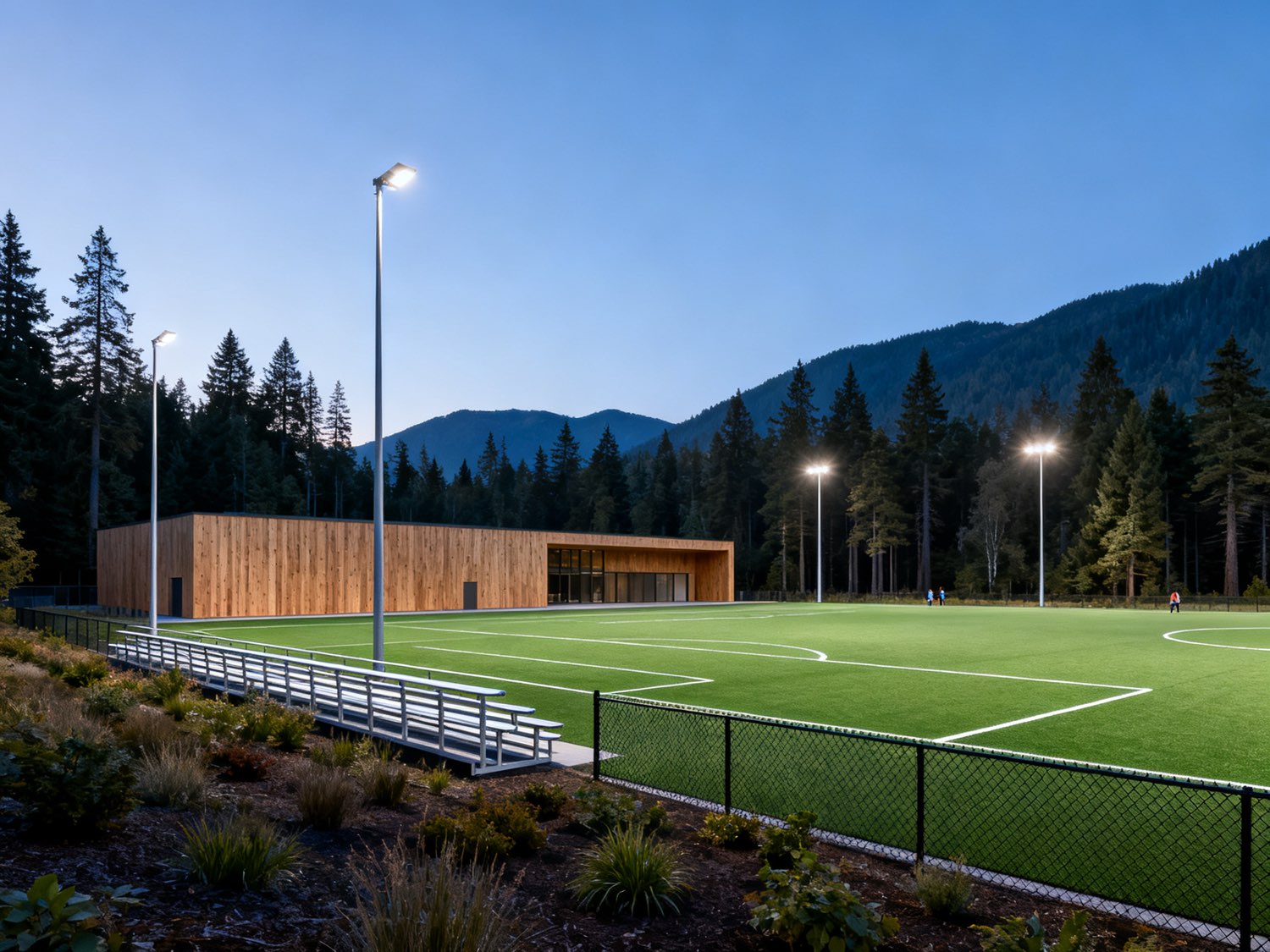
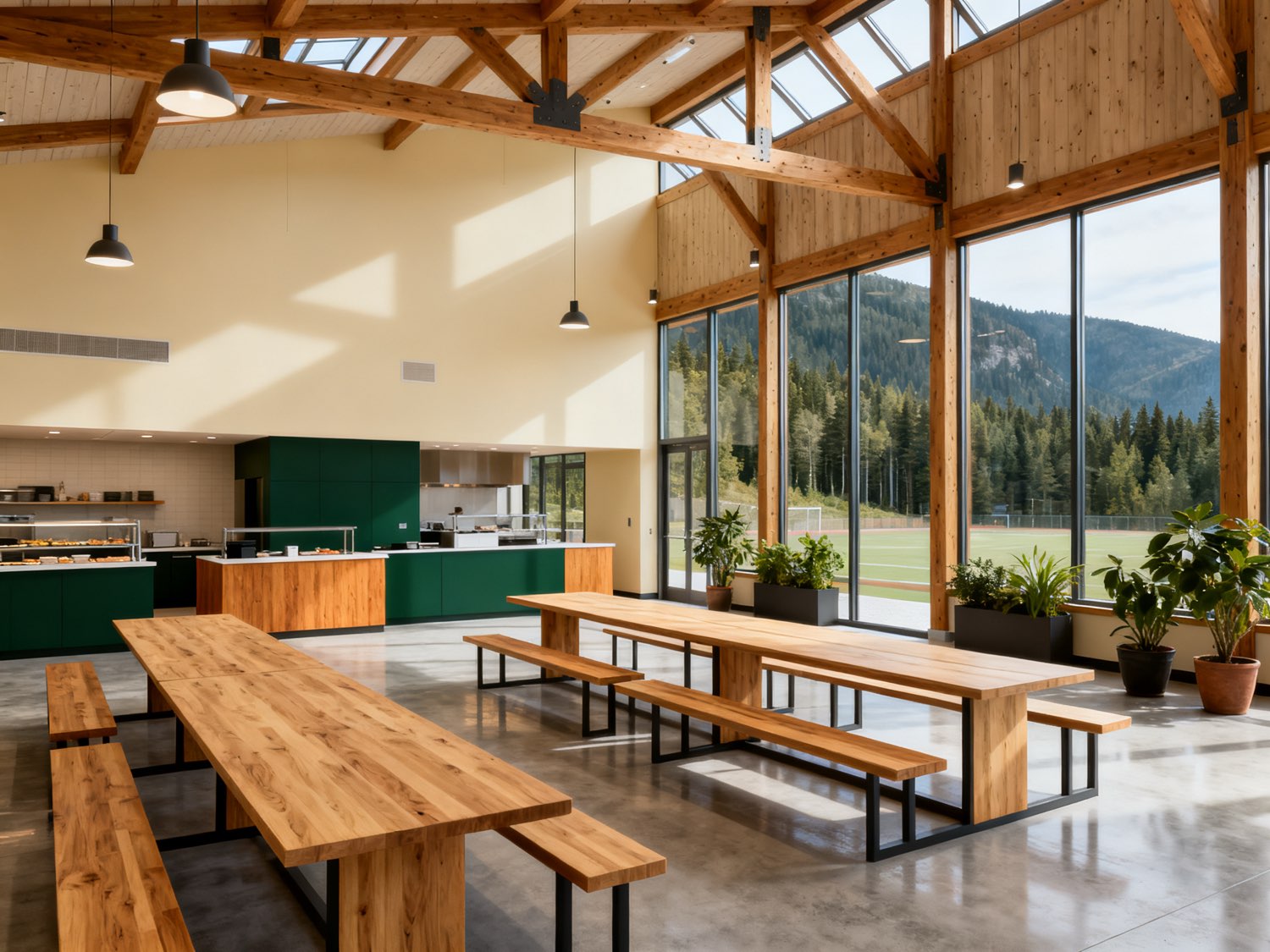
The core investment case is an integrated campus: an indoor facility of approximately 100,000 square feet containing three full-size basketball courts including a premier competition court with approximately 1,000 spectator seats, six pickleball courts, rock climbing and bouldering, a mezzanine running and walking track, dance studio, strength and performance training, a sports medicine and therapy centre, team and media facilities, and a food hall and sports lounge. The court hall converts for volleyball, badminton, concerts, conferences, trade shows, and community events. Outdoors, the program includes a full-size FIFA-standard multi-use turf field, family playground, dog park, and gathering landscape designed to low-impact development standards. All component areas are indicative planning allocations pending schematic design requires validation. Workforce and student housing, previously bundled into early estimates, is evaluated as an adjacent, later-phase opportunity under the broader CVSEEII and is not part of the core case; final scope confirmation remains an open gate requires validation.
The Positioning
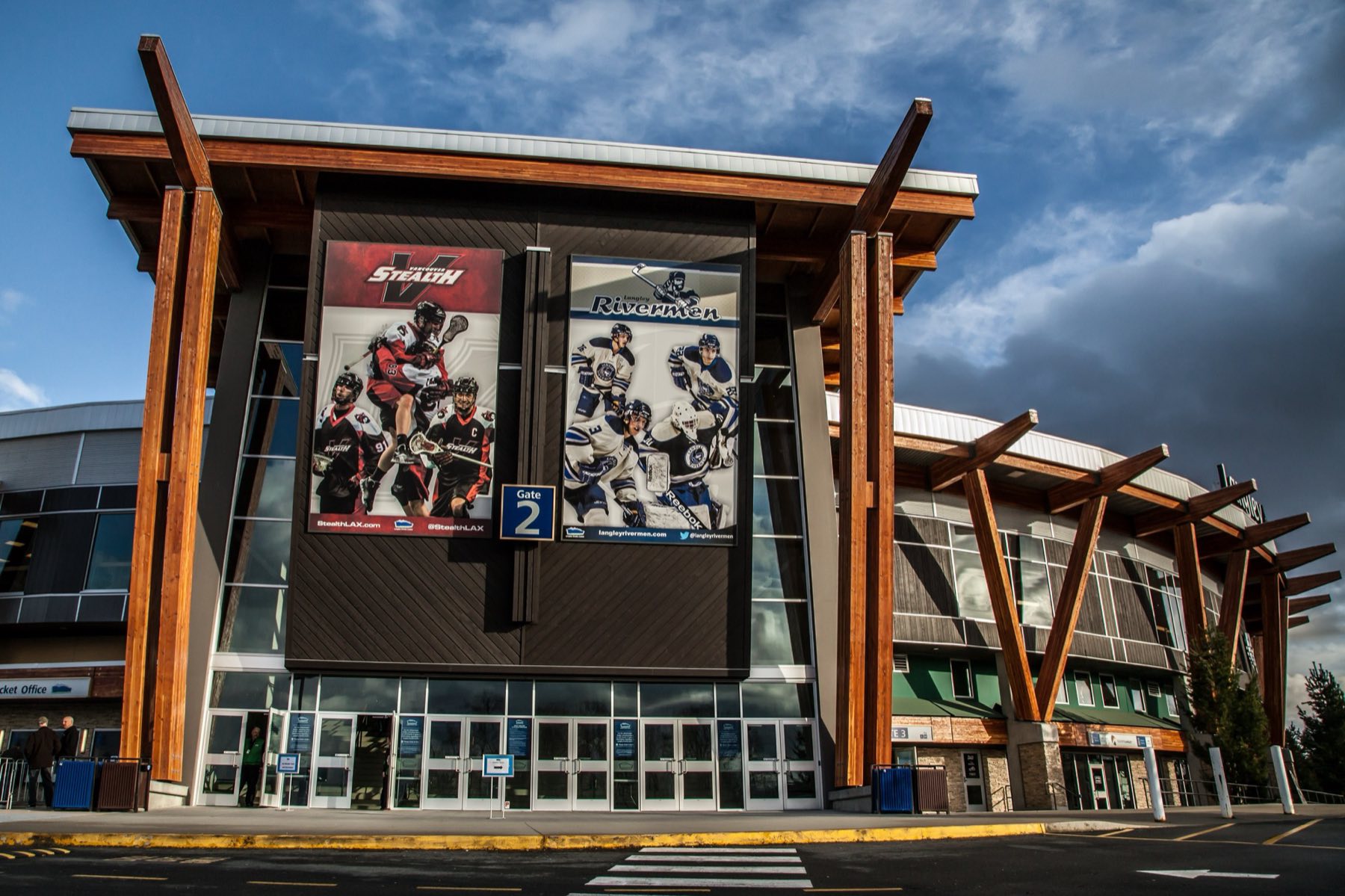
The sizing is a decision, not a compromise. At roughly one third the scale of Langley Events Centre, the provincial benchmark venue, Champions is positioned for Island-tier and regional events, daily community use, and year-round programming, not head-to-head competition with Lower Mainland mega-venues.[source: Langley Events Centre public facility data] The commercial thesis is counter-seasonal: Island accommodation occupancy peaks at 88 percent in August and falls to 41 percent in January, while indoor court sport runs October through April.[source: Destination BC, Vancouver Island Regional Profile, 2025, CoStar 2024 data] Champions is designed to be the region's counter-seasonal demand engine, generating visitation in precisely the months the existing tourism economy cannot fill on its own.
The Hotel Strategy Framework
An on-site, team-friendly hotel is treated as a core business unit and its own entity, not an amenity. It is the only component of the project presented as conventionally debt-capable, and even that only on evidence. This plan fixes no room count. It carries 80, 100, and 120 room scenarios, with 80 rooms as the operator base case on the sequencing lesson of comparable campuses that opened small and expanded on proven demand. No public Cowichan-specific occupancy or rate data exists, which is itself a finding, and an independent hotel market and feasibility study is a hard gate before any room count, brand conversation, or debt sizing requires validation.
The Operating Economics and Capital Posture
This plan does not claim the sports facility will be commercially self-sustaining on sports operations alone. The best available market-tested evidence points the other way: comparable facility pro formas show modest stabilized operating income before debt service, and major public complexes in North America operate deliberately as subsidized community assets.[source: Victus Advisors, Prince William County feasibility study, 2024] Champions is therefore structured as a cross-subsidized model in which hotel, events, food and beverage, and sponsorship revenue carry the sports floor and fund the Champions Fund, with facility operations targeted near breakeven after a funded three-year ramp. Modeled stabilized facility revenue, excluding the hotel entity, is an indicative $1.4 million to $2.7 million requires validation. The financial sections present the facility, the hotel entity, and the Champions Fund separately, so the cross-subsidy is visible rather than blended away, and Section 16 models the scenario where the cross-subsidy falls short rather than assuming it away.
No headline capital figure is presented in this plan, and that is deliberate. The development budget is a component-level framework, pre-quantity-surveyor, with every line carrying a requires-validation marker requires validation. An earlier preliminary estimate is treated as a superseded artifact because it included housing scope now evaluated outside the core case; the reconciliation appears in Section 14. Capital is organized into two stacks that are never blended: a hotel stack that is debt-capable in principle, and a sports and community stack whose character is grants, equity, philanthropy, and long-term community funding mechanisms. The funding landscape is presented as it is: no open federal capital program of matching scale is currently identified, and capital sequencing and structuring are the role of Mycelium Capital once this document set is complete. One condition precedent governs all of it: no capital raising, QS costing, or hotel flag conversation begins before the four immediate gates named under Immediate Milestones close. All financial figures in this plan are modeled, not guaranteed, and subject to final documentation.
Community and Economic Impact
Impact is evidenced, not asserted. The Champions Fund, a nonprofit with independent directors, receives defined revenue shares and philanthropy and funds a protected community-access floor, held even on tournament weekends and enforceable under the facility lease. The project commits to annual SEE impact reporting through the Green Nation Collective framework, with economic impact to the region always reported separately from project revenue and investor returns. This version publishes an impact methodology, not a headline figure; no economic impact dollar amount appears until the utilization study and event calendar are modeled requires validation.
Where the Project Stands
The current stage: concept, positioning, and program are defined; this document completes the plan structure. No site is controlled. No water, wastewater, or servicing capacity data is yet held, and water readiness is treated as a master-planning condition, not a detail. The prior financial workbook was found not investment-grade and has been rebuilt bottom-up with assumptions exposed. Partner relationships, including the school district, VIU, municipal planning, suppliers, and community organizations, are initiated but not yet converted to commitments requires validation.
Immediate Milestones
Delivery runs through a sixteen-gate roadmap measured by evidence, not dates. Four gates come first, and they close before any capital raising, QS costing, or hotel flag conversation begins: sponsor confirmation of scope and name; Nation-specific, government-to-government dialogue opened before concepts are fixed; site identification and land control; and confirmed water and servicing readiness. Behind them sit the demand and utilization study, the hotel market study, and quantity surveyor costing that turn this plan's modeled ranges into bankable numbers.
The Partnership Invitation
The goal is not to become the organization that delivers every program. The goal is to be the platform that helps the best programs succeed. This plan is an invitation to come alongside: to local governments, School District 79, VIU, sport organizations, health partners, funders, and community organizations whose participation turns shared infrastructure into regional capacity. First Nations are rights holders and governments, never stakeholders; the governance structure holds open the full range of participation options, from governance participation to co-ownership, entirely at each Nation's discretion and through each Nation's own process, and this plan presumes none of them.
What this plan asks for now is specific. No capital is being raised, and none will be raised before the four immediate gates close. The near-term invitation is to partners: converting the relationships already initiated into the letters of intent and memoranda of understanding targeted at Gate 12, and participating in the pre-development study workstreams on utilization, the hotel market, water and servicing, and quantity surveyor costing. Capital conversations begin only through Mycelium Capital, once this document set is complete. Sections 17 and 20 set out both pathways in full.
What follows is the full case: the vision and principles that govern the project, the regional context that justifies it, the market and program definition, the commercial model with its assumptions exposed, and the risk and delivery framework that turns intent into accountability. The plan is designed to be clear, current, and credible. Where the evidence is strong, it says so. Where validation is still required, it says that too.
2 Vision, Mission and Development Principles
Vision
A gathering place where the Cowichan Valley plays, competes, heals, and celebrates together. Champions Sports Grounds exists so that a child in Duncan, a masters athlete in Ladysmith, a visiting team from Victoria, and a family that could not otherwise afford registration fees all walk through the same doors, onto the same courts, under the same roof.
The vision is built on four reinforcing foundations, and the order is deliberate:
- Local community use first. The facility is designed, programmed, and priced for the people who live here: youth leagues, school sport, seniors wellness, adult recreation, and daytime programming that fills the hours tournaments never touch. Community access is a designed outcome with a protected floor of hours, not a residual of commercial scheduling.
- Sports tourism as the economic engine. Weekend and shoulder-season tournaments, sized honestly to the facility's three basketball courts and six pickleball courts, bring visiting teams and families whose spending flows through the hotel, the food hall, and the wider regional economy, particularly in the off-season months when the Island's visitor economy is quietest.
- Integrated hospitality. An on-site, team-friendly hotel is a core business unit, not an amenity. It converts tournament demand into room nights the region currently exports, and its earnings are one of the revenue lines that carry the community mission.
- Community impact through the Champions Fund. A nonprofit fund, resourced by facility and hospitality revenues, subsidizes access for children, families, and individuals who might otherwise be excluded because of cost. Impact is evidenced through the fund's flows, reported annually, never asserted without numbers.
Mission
To develop and operate an integrated sports, wellness, events, and hospitality destination that measurably strengthens the social, environmental, and economic wellbeing of the Cowichan Valley, and to do it with the discipline, transparency, and partnership standards set by the Cowichan Valley SEE Impact Initiative.
Development Principles
These principles are binding on every subsequent section of this plan. Where a later decision conflicts with a principle, the principle governs.
- Recognition of First Nations as rights holders and governments. The Cowichan Valley lies within the ancestral and unceded territories of First Nations who are rights holders, governments, land stewards, and economic development leaders, never stakeholders.[source: CVSEEII framework] Engagement is Nation-specific, follows each Nation's own protocols and consent pathways, and begins before site and concept decisions are fixed. This plan does not speak for any Nation, does not presume any Nation's interest or participation, and does not use Indigenous culture as branding. Partnership options, from governance participation to economic participation to co-development, exist entirely at each Nation's discretion.
- Convene, don't own. The project succeeds by aligning schools, sport organizations, health partners, local governments, and community groups around shared infrastructure. The goal is not to become the organization that delivers every program. The goal is to be the platform that helps the best programs succeed.
- Planned-together outcomes. Social, environmental, and economic outcomes are designed together from the first master-planning decision. They are never traded off against each other or sequenced as afterthoughts.
- Regenerative, not conventional, growth. The measure of success is not visitor volume for its own sake. It is whether the region is stronger: healthier residents, retained spending, off-season employment, and facilities the community actually uses.
- Evidence over claims. Every number in this plan carries a source or a requires-validation marker. Modeled means modeled. Nothing is presented as bankable before quantity-surveyor costing, hotel feasibility, and utilization studies are complete. Impact is reported with the same rigour as revenue.
- Community access and equity by design. Tournament and visitor revenue subsidizes access for those who might otherwise be excluded because of cost. The community-access floor, in hours per week, is protected even on event weekends, and the programming policy in Section 10 makes the priority order explicit.
- Financial honesty about the operating model. The sports floor is not underwritten as a standalone profit centre, because the sector evidence says it is not one. Hotel, events, food and beverage, and sponsorship carry the facility and the Champions Fund. The plan shows the scenario where they do not.
- Water and infrastructure readiness as master-planning conditions. Servicing capacity, watershed constraints, and site infrastructure are gate-one questions, examined before site commitment, not engineering details resolved later. If it ignores water, the plan will fail.[source: CVSEEII framework]
- Discipline and role separation. Green Nation Collective holds the impact framework and SEE assessment. Foundry House holds organizational and delivery infrastructure. Mycelium Capital holds capital strategy, investment structuring, and execution sequencing once this document set is complete. This plan describes the funding landscape; it does not prescribe capital sequencing, because that is not its role.
- Profit as fuel, not extraction. Surpluses are recycled into access, maintenance reserves, and regional impact. The project is designed to endure, which means capital maintenance is budgeted from day one and success is measured over decades, not exit windows.
3 Regional Strategic Context
A growing region of nearly 96,000 people, inside a half-million-person corridor, is receiving a generational healthcare investment while losing its economic development function, and it lacks the multi-court community sports and gathering infrastructure this plan defines. The sections below lay out that context in full.
3.1 A Growing Region on the Island's Main Corridor
The Cowichan Valley Regional District recorded a 2021 Census population of 89,013, up 6.3 percent from 83,739 in 2016.[source: Statistics Canada, 2021 Census Profile, CVRD] Growth was broad-based rather than concentrated: all four municipalities grew, led by North Cowichan at 31,990 (up 7.7 percent), with Ladysmith at 8,990, Duncan at 5,047, and Lake Cowichan at 3,325, and all nine electoral areas grew as well, led by the lake-area communities where local directors attributed in-migration to young families relocating for affordability.[source: Cowichan Valley Citizen, Feb 16, 2022, reporting Statistics Canada 2021 Census] Current estimates place the regional population near 95,800 in 2025, with BC Stats projections indicating growth toward roughly 110,000 by 2046 requires validation; the projection vintage should be re-pulled from current BC Stats tables before publication.[source: citypopulation.de compiling BC Stats estimates; BC Stats regional district projections]
The region sits on the Trans-Canada Highway roughly midway along the 111 kilometre corridor between the Island's two metropolitan markets. The 2021 Census counted 397,237 people in the Victoria CMA (up 8.0 percent) and 115,459 in the Nanaimo CMA (up 10.0 percent), placing roughly 513,000 people within an approximately one-hour drive of the central Valley.[source: Statistics Canada, 2021 Census, CMA profiles] A formal drive-time population study covering 60, 90, and 120 minute rings, including ferry-connected markets, has not yet been commissioned and is a named requirement of the market analysis requires validation. The workforce is already regionally integrated: 2021 commuting data shows 24.6 percent of employed residents working outside the region, primarily toward Victoria and Nanaimo, evidence of real two-way labour and customer flow along the corridor.[source: Economic Development Cowichan, State of the Cowichan Economy, Winter 2023]
Three demographic facts shape the programming logic. First, the region skews older than the province: average age in the Cowichan Valley North health area is 48.6 years against 42.0 for BC, the 45 to 64 cohort is the largest, and the 75-plus population is projected to grow 63.3 percent by 2044, which argues for daytime adult and seniors wellness programming alongside youth sport and flags a long-term headwind for purely youth-driven utilization assumptions.[source: Island Health, Cowichan Valley North LHA Profile, 2021 Census data] Second, household incomes sit below the provincial median, at approximately $79,500 against $85,000 for BC, with 12.1 percent of children in low-income households; this income gap is direct evidence for the Champions Fund access-subsidy rationale rather than a purely commercial pricing model.[source: Economic Development Cowichan, State of the Cowichan Economy, Winter 2023; Island Health LHA Profile] Third, 12.6 percent of residents, 10,985 people, identified as Indigenous in 2021, more than double the provincial share and the region's fastest-growing population group; this is regional context only, and the priorities of the Nations are theirs to define.[source: Statistics Canada, 2021 Census Profile, CVRD]
Growth has a cost side that this plan takes seriously. North Cowichan's 2024 Interim Housing Needs Report quantifies a five-year need of 2,172 new units in that municipality alone, nearly four in ten CVRD households in core housing need are in extreme need, and the regional benchmark house price reached $752,700 in 2022.[source: Municipality of North Cowichan, 2024 Interim Housing Needs Report; Inclusion BC / SPARC BC, 2024 CVRD snapshot] Housing pressure affects this project directly, through workforce recruitment in a constrained market, and it is one reason the broader CVSEEII evaluates workforce housing as an adjacent initiative rather than leaving it inside this project's core case.
3.2 First Nations Governments and the Territories of the Region
The Cowichan Valley lies within the ancestral and unceded territories of First Nations who are rights holders and governments, never stakeholders. The region is home to ten First Nations. The CVSEEII framework identifies nine by name: Quw'utsun (Cowichan Tribes), MALEXEL (Malahat), BOKECEN (Pauquachin), Ts'uubaa-asatx, Halalt, Spune'luxutth (Penelakut), Stz'uminus, Leey'qsun (Lyackson), and Ditidaht, with Pacheedaht flagged for further research, and it requires Nation-specific rights-holder mapping before any public-facing development concept advances.[source: CVSEEII framework] Each Nation has its own government, protocols, and consent pathways, and they cannot be collapsed into one category. This plan follows that standard: nothing in this document states or implies any Nation's position on this project.
Two regional facts frame the legal and governance environment. Cowichan Tribes is the largest single First Nation band in British Columbia by population, with more than 5,500 members across seven traditional villages, and its lands and government sit at the centre of the Valley adjacent to Duncan.[source: cowichantribes.com/about-cowichan-tribes] In August 2025, the BC Supreme Court declared Aboriginal title held by the Quw'utsun Nation in Cowichan Tribes v. Canada, 2025 BCSC 1490, directing federal and provincial governments to negotiate reconciliation of Aboriginal title with existing fee simple interests; appeal status should be confirmed before publication requires validation.[source: Cowichan Tribes v. Canada, 2025 BCSC 1490; JFK Law commentary] For this plan, the decision confirms what the initiative's protocol already requires: site strategy in this region begins with government-to-government dialogue, and early Nation-specific engagement on any candidate parcel is a master-planning condition, not a courtesy.
The Nations of the region are active economic development leaders, on their own terms and through their own institutions. Cowichan Tribes restructured its business holdings in 2025 under the Quw'utsun Holdings General Partnership, with Khowutzun Development Corporation, founded in 1993, as its economic development corporation.[source: cowichantribes.com, economic development] Malahat Nation operates Yos Economic Development Corporation and Malahat Investment Corporation, acquired a portion of its traditional homelands in 2015 through First Nations Finance Authority financing, and generated profit through the Malahat SkyWalk visitor attraction.[source: malahatnation.com/business; Malahat Nation 2022-23 annual report] Stz'uminus First Nation's Coast Salish Group has master-developed the 65-acre Oyster Bay commercial lands near Ladysmith.[source: coastsalishgroup.com] Ts'uubaa-asatx Nation holds a 2013 protocol agreement with the Town of Lake Cowichan and is investing in cultural and nature-based tourism at Cowichan Lake.[source: BC Gov News 2023IRR0044; Saanich News, Apr 14, 2025] Halalt First Nation acquired two commercial properties in North Cowichan in 2020 under incremental treaty arrangements.[source: BC Gov News 2020IRR0007] These facts are recorded here as regional context. Whether, how, and through which entity any Nation might choose to engage with this project is entirely each Nation's decision, through its own process.
The region also holds a significant sports-hosting fact: Cowichan hosted the 2008 North American Indigenous Games in Duncan, drawing more than 5,000 athletes under a bid led by Cowichan Tribes and BC First Nations, with a formal legacy plan.[source: naigcouncil.com; yasc.ca] It is cited here solely as evidence of regional hosting capacity.
3.3 The Hospital Anchor
The single largest force reshaping the regional economy through this decade is the new Cowichan District Hospital: a $1.446 billion project with 204 inpatient beds, opening to patients in 2027, cost-shared between the Province through Island Health and the regional hospital district.[source: Island Health, Cowichan District Hospital Replacement Project; Infrastructure BC] The Province announced in 2025 that the hospital will carry the name Quw'utsun Valley Hospital / Quw'utsun Hulitun-ew't-hw through partnership with Cowichan Tribes, and Cowichan Tribes firms participated in construction; those facts are recorded here as regional context.[source: BC Gov News 2025INF0055; Times Colonist]
The hospital matters to this plan in three ways. As a demand anchor, it concentrates hundreds of clinical, trades, and support workers, and their families, in the central Valley; Island Health is actively recruiting trades and clinical staff ahead of opening, though no public total-jobs figure exists and one should be requested from Island Health requires validation.[source: Island Health, project job opportunities page] As a wellness anchor, it strengthens the case the CVSEEII framework makes for the Valley as a regional health and wellbeing node, in which recreation infrastructure is part of the prevention system, not separate from it.[source: CVSEEII framework] And as a cautionary cost datapoint: the project's budget escalated from $887 million to $1.446 billion, a $559 million increase attributed to market escalation and scope.[source: Times Colonist] The same construction-cost environment applies to Champions Sports Grounds, which is why every capital figure in this plan is pre-quantity-surveyor and carries a requires-validation marker until QS costing is complete.
3.4 The Coordination Gap
The CVRD Board discontinued funding for Economic Development Cowichan effective February 20, 2026, and as of that date the regional district no longer has staff resources assigned to the function.[source: cvrd.ca economic development service page; Cowichan Valley Citizen, Feb 10, 2026] The CVSEEII framework is direct about what this means: the loss of formal staff resources does not remove the need for regional economic development, it makes coordinated economic stewardship more important, and the risks include fragmented development, lost regional coordination, limited investment readiness, missed funding opportunities, and reduced capacity to coordinate multi-partner initiatives.[source: CVSEEII framework]
For a project of this scale, the gap cuts both ways. There is no regional economic development office to champion, coordinate, or evaluate a proposal like this one. There is also no incumbent process to inherit. The initiative's answer is not to replace what was lost, but to convene around it.
3.5 The Initiative and This Project's Place In It
The Cowichan Valley SEE Impact Initiative exists to fill exactly this kind of gap: a regional stewardship platform that aligns partners, standards, opportunities, investment readiness, and impact measurement around social, environmental, and economic outcomes designed together.[source: CVSEEII framework] Within it, roles are separated by design. Green Nation Collective holds the SEE assessment and impact framework, Foundry House holds delivery infrastructure, and Mycelium Capital organizes capital and execution logic once planning documents are complete.
Champions Sports Grounds is Catalyst Two of the initiative, covering sports, community wellness, and sports tourism. The GNC SEE evaluation scored the concept 80 out of 100 for impact potential and 82 out of 100 for ecosystem opportunity.[source: GNC SEE evaluation] The CVSEEII master framing evaluates it as the Cowichan Valley Champions Complex, a regional wellness and gathering node, and the CVSEEII framework sets the evaluation standard this plan adopts: the key question is not whether the region can build a facility, but what kind of facility would create the greatest regional benefit, judged against community need, youth access, affordability, facility gaps, operating model, land and infrastructure readiness, environmental fit, and long-term financial sustainability.[source: CVSEEII framework]
The regional context resolves to a single strategic statement. A growing region of nearly 96,000 people, inside a half-million-person corridor, is receiving a generational healthcare investment while losing its economic development function, and it currently lacks the kind of multi-court community sports and gathering infrastructure this plan defines. Champions Sports Grounds is proposed as one of the physical anchors of the region's wellness and gathering strategy, advanced with the discipline the initiative demands: rights-holder recognition first, water and site readiness proven before commitment, and every financial claim either evidenced or marked for validation.
4 Site and Land Strategy
Champions Sports Grounds does not yet control a site. No parcel has been selected, optioned, or acquired, and this plan does not pretend otherwise. That fact shapes everything in this section. Rather than describing a property, this section sets out the framework by which a site will be selected, evaluated, and brought under control, and it defines land control as gate one of the implementation roadmap. Every subsequent commitment in this plan, from quantity surveyor costing to hotel feasibility to capital conversations, is conditional on gate one closing.
Site control, together with confirmed water, wastewater, and infrastructure servicing, is the condition precedent for this entire plan. No capital raising, no QS costing, and no hotel flag conversations proceed before gate one closes.
4.1 Where land strategy begins: territory and government-to-government dialogue
The Cowichan Valley sits within the ancestral and unceded territories of multiple First Nations whose relationship to the land, water, village sites, travel routes, and cultural places extends back since time immemorial.[source: CVSEEII framework] The CVSEEII framework identifies at least nine Nations of the region by name, with a tenth flagged for research, and requires Nation-specific rights-holder mapping before any concept advances.[source: CVSEEII framework] They are rights holders and governments. They are not participants in a consultation checklist, and they do not appear anywhere in this plan as a category of stakeholder.
The legal landscape reinforces what respect already requires. In August 2025 the Supreme Court of British Columbia, in Cowichan Tribes v. Canada (Attorney General), 2025 BCSC 1490, recognized Aboriginal title of the Cowichan Nation to a portion of its historic village lands and an Aboriginal right to fish in the south arm of the Fraser River.[source: Cowichan Tribes v. Canada (Attorney General), 2025 BCSC 1490] The appeal status of that judgment should be confirmed before publication requires validation. For this plan the judgment is not a risk line. It is confirmation of how land work in this region properly begins: with government-to-government dialogue, Nation by Nation, according to each Nation's own protocols, before any concept is fixed to a parcel.
Practically, this means site identification and Nation-specific dialogue run in parallel from the start, not in sequence with dialogue bolted on after a shortlist exists. Which lands, interests, cultural sites, or priorities connect to any candidate area is for each Nation to identify through its own process. The plan does not speculate on those interests, and it does not assume any Nation's participation in, position on, or interest in this project. If any Nation chooses to explore a land-related or economic relationship with Champions Sports Grounds, the pathway, pace, and terms of that conversation belong to the Nation.
4.2 Search geography
Without naming candidate parcels, the search logic can be stated plainly. The project's demand model depends on two catchments at once: the regional and corridor populations established in Section 3.1, connected along the Trans-Canada Highway corridor. The CVSEEII framework identifies the Trans-Canada corridor as the connective spine of the region, linking the Valley internally and to Greater Victoria and Nanaimo, and identifies Central Cowichan as the regional service centre whose infrastructure affects the broader Valley.[source: CVSEEII framework]
The search area therefore prioritizes sites with direct or near-direct Trans-Canada Highway access within the central corridor of the region, where BC Transit's existing Cowichan Valley network, including the Cowichan to Victoria and Nanaimo connections, can serve local users who do not drive.[source: BC Transit, Cowichan Valley Regional Transit] A tournament facility that only cars can reach fails the community-first test on its own terms.
4.3 Site evaluation framework
Candidate sites will be scored against the criteria below before any control instrument is negotiated. The framework draws on the environmental and land suitability lens set out in the CVSEEII framework, which directs that projects be evaluated for slope stability, fire risk, agricultural land impact, habitat and cultural sensitivity, Indigenous rights and interests, transportation access, infrastructure cost, and climate resilience, and that the framework be used to improve projects, not only to reject them.[source: CVSEEII framework]
| Criterion | What it tests | Current evidence position |
|---|---|---|
| Nation-specific considerations | Whether lands, cultural sites, or interests identified by any Nation through its own process connect to the candidate area | Established through government-to-government dialogue only; never assessed unilaterally by the project |
| Water and servicing readiness | Confirmed potable water, wastewater, and stormwater capacity for the full program, under drought and growth conditions | No site-level data exists yet; see the readiness gate in 4.4 |
| Land area and configuration | Ability to hold the indoor envelope, outdoor field, hotel, parking, and bus circulation with room for phasing | Indicative requirement modeled in 4.5 requires validation |
| Highway and transit access | Trans-Canada corridor access for tournament traffic; BC Transit service for daily community use | Corridor and network confirmed regionally; site-level access study pending requires validation |
| Zoning and OCP alignment | Fit with the relevant municipal or electoral-area Official Community Plan; rezoning pathway and timeline if required | Jurisdiction unknown until a site is identified requires validation |
| Agricultural Land Reserve status | Avoidance of ALR lands; the project does not seek to remove farmland from the reserve | Screening criterion; ALR parcels excluded from the search |
| Environmental and hazard conditions | Floodplain exposure, riparian setbacks, slope, wildfire interface, habitat and archaeological sensitivity | Assessed per candidate site through required studies requires validation |
| Infrastructure cost and public burden | Upgrade requirements, long-term maintenance obligations, and whether the project helps solve or worsens the public infrastructure burden | Per-site engineering assessment pending requires validation |
| Community fit | Proximity to schools, the new hospital, and existing recreation assets; compatibility with neighbouring uses; contribution to village and regional life | Qualitative assessment at shortlist stage |
| Acquisition economics | Land cost, control instrument options, and carrying cost against the development budget | Unknown until candidate sites identified requires validation |
The framework table above is a screening and evaluation instrument adapted from the CVSEEII framework's land suitability lens; it contains no modeled figures, and its evidence-position column shows the current validation status of each criterion.[source: CVSEEII framework]
A site that fails the water criterion fails, whatever its other merits. A site that scores moderately across all criteria may still be improved through design, servicing partnership, or low-impact development practice, which is the intended use of the framework.
4.4 The water, wastewater, and servicing readiness gate
The current evidence base for this plan contains no water, wastewater, or servicing capacity data at all. Not partial data. None. The CVSEEII framework is unambiguous that water infrastructure is one of the most important determinants of development feasibility in the Cowichan Valley, that drought is one of the most important climate-related risks facing the region, and that development should be evaluated against watershed capacity before concepts become fixed, a principle it formalizes as a water-first development standard.[source: CVSEEII framework] A plan for a water-consuming destination facility that wrote around that gap would fail on its own philosophy. This plan names the gap instead.
The following are open data requirements, each of which must be answered at the candidate-site level before gate one can close:
- CVRD or municipal potable water servicing capacity at each candidate site, including fire protection flows for a building of approximately 100,000 sq ft requires validation
- Wastewater servicing capacity, treatment headroom, and connection feasibility, or septic suitability where municipal servicing is absent, including soil and groundwater impact assessment requires validation
- Cowichan watershed constraints, including summer low-flow and drought conditions, ecological flow requirements, and the water storage context of Cowichan Lake and its weir requires validation[source: Cowichan Watershed Board]
- Groundwater availability and aquifer condition for any site not fully served by community water systems requires validation
- Stormwater management capacity and downstream effects, assessed against low-impact development standards rather than conventional hard infrastructure alone requires validation
- Irrigation demand for the outdoor turf field and landscape program under drought-year restrictions requires validation
Design commitments follow from the same discipline. The facility will be designed to the low-impact development practices the CVSEEII framework identifies for the region, including rainwater capture, permeable surfaces, bioswales, native planting, riparian buffers where relevant, and reduced impervious area, treated as part of the infrastructure model rather than an aesthetic add-on.[source: CVSEEII framework]
4.5 Indicative land requirement
The full program implies an indicative site requirement in the range of 15 to 25 acres requires validation. This is a modeled planning range, not an engineered one. It is built from the indoor envelope of approximately 242 feet by 402 feet (roughly 97,300 sq ft of footprint), a full-size FIFA-standard turf field with run-offs and spectator edge, surface parking sized for tournament peaks, hotel pad and servicing under the 80 to 120 room scenarios, team bus circulation and loading, the outdoor family program (playground, dog park, gathering areas), and stormwater management area. The final requirement depends on parcel geometry, parking strategy (surface versus any structured component), and servicing easements, and will be fixed only through concept master planning on an actual candidate site.
4.6 Land control pathways and the definition of gate one
Four control pathways will be evaluated once a preferred site emerges, in each case tested against the development budget and the governance structure in Section 13, under which land and improvements are held by the Property Company:
- Fee-simple purchase, the cleanest structure for long-term stewardship, weighed against upfront capital consumption.
- Option to purchase, securing exclusivity through the feasibility period at limited cost, with QS costing and servicing studies completed inside the option window.
- Long-term ground lease (49 years or longer) from a public, institutional, or private landowner, preserving capital for the building program in exchange for a permanent operating cost.
- Land partnership structures, in which a landowner participates in the Property Company. Should any First Nation ever choose, entirely through its own governance and on its own terms, to explore a land-related relationship, that conversation would be welcomed and would follow the Nation's protocols. This plan assumes nothing of the kind and builds no scenario on it.
Gate one closes when all of the following are true: a site is under legal control through one of the pathways above; water, wastewater, and servicing capacity are confirmed in writing by the servicing authority for the full program; the zoning or rezoning pathway is confirmed with the responsible local government; and Nation-specific dialogue relevant to the candidate area has been initiated and is proceeding according to each Nation's own process. Until then, every downstream number in this plan, including the development budget and all hotel scenarios, remains provisional by design.
5 Master Development Program
The development program is the physical answer to the positioning: a community-first, tournament-enabled sports and hospitality destination. It is designed as one integrated place, not a collection of amenities, and it is deliberately sized for the market it actually serves. At approximately 100,000 sq ft of indoor program, Champions is roughly one third the size of Langley Events Centre, the benchmark BC tournament venue at 322,312 sq ft.[source: Langley Events Centre public facility data] That sizing is a decision, not a compromise. It positions the facility for Island-tier and regional events, daily community use, and year-round programming rather than head-to-head competition with Lower Mainland mega-venues.
Nothing in the region offers what this program combines. The region's own recreation plan lists no dedicated multi-court gymnasium or fieldhouse (the full inventory appears in Section 6.3).[source: CVRD Regional Recreation Strategic Plan, Final Draft for Public Review, Sept 2025] That absence, observed in the region's own planning document, is the gap this program addresses.
All component areas below are indicative planning allocations pending schematic design. The table is modeled. It exists so the program can be tested, costed, and challenged, not so it can be treated as settled.
5.1 Indoor program (approximately 100,000 sq ft; envelope approximately 242 ft by 402 ft)
| Component | Description | Indicative area (sq ft, modeled) |
|---|---|---|
| Main court hall | 3 full-size basketball courts including a premier competition court with approximately 1,000 spectator seats; divider curtains and event rigging | 38,000 to 44,000 requires validation |
| Pickleball hall | 6 dedicated pickleball courts with buffers, serving the region's fastest-growing racquet demand | 9,000 to 11,000 requires validation |
| Climbing and bouldering centre | Rope climbing and bouldering with youth-program focus | 5,000 to 7,000 requires validation |
| Strength, fitness, and performance gym | Community fitness plus athlete performance training | 6,000 to 8,000 requires validation |
| Dance studio | Sprung-floor multi-purpose studio | 1,500 to 2,500 requires validation |
| Sports medicine and therapy centre | Physiotherapy, athletic therapy, and recovery services | 2,500 to 4,000 requires validation |
| Mezzanine running and walking track | Elevated track ringing the court hall; a core daytime asset for a region where 24 percent of residents are 65 and over[source: CVRD Regional Recreation Strategic Plan] | 8,000 to 10,000 at mezzanine level requires validation |
| Team and event support | Team rooms, change rooms, coach and referee lounges | 5,000 to 7,000 requires validation |
| Film and strategy room | Theatre-style room for game review, coaching education, and community screenings | 1,500 to 2,500 requires validation |
| Media and content suite | Game recording, livestream, analytics infrastructure; recording and content studio | 1,500 to 2,500 requires validation |
| Food hall and coffee bar | All-day food and beverage anchoring the social heart of the building | 4,000 to 6,000 requires validation |
| Sports lounge | Licensed lounge overlooking the courts | 2,000 to 3,000 requires validation |
| Lobby, administration, circulation, storage, mechanical | Balance of program | Approximately 15 to 20 percent of gross area requires validation |
These allocations must reconcile to the built envelope through schematic design, and every one of them feeds the QS costing exercise that follows gate one. None is bankable today.
5.2 Outdoor program
- Full-size FIFA-standard soccer and multi-use turf field, the outdoor tournament anchor and daily community field. Turf specification, lighting, and drought-year irrigation strategy are design-stage decisions tied to the Section 4 water gate requires validation. A turf replacement sinking fund on an 8 to 10 year cycle is built into the operating model from day one (Section 12).
- Family playground, positioned so a parent can watch one child on the field and another on the playground. This is the community-first promise made physical.
- Dog park, extending daily-use reasons to visit beyond sport.
- Landscaping and gathering areas, designed to low-impact development standards, with native planting, permeable surfaces, and stormwater integrated as infrastructure rather than decoration.[source: CVSEEII framework]
5.3 Hospitality program
The hotel is a core business unit and its own entity in the governance structure, not an amenity. Consistent with Section 8, no room count is fixed here. The program carries 80, 100, and 120 room scenarios, with 80 rooms as the operator base case, and the independent hotel market study is a named gate before any count is committed requires validation. The sequencing lesson from comparable campuses is set out in Section 8.4: open small, expand on proven demand.
Team-friendly requirements carried into the hotel brief: double-queen rooms and suites, group check-in, meeting rooms, secure equipment storage, guest laundry, group meal capability, bus loading, recovery amenities, a share of extended-stay units, and a direct pedestrian connection to the sports building.
5.4 Program elements not yet integrated
Naming what the current concept drawings do not yet resolve is part of the discipline. The following are known gaps to be closed in concept master planning, not features of the current plan:
- Hotel siting and servicing integration with the sports building
- Team bus circulation, drop-off, and layover
- Parking strategy, including whether any structured component is warranted
- A complete outdoor master plan tying field, playground, dog park, and gathering areas into one landscape
5.5 Conversion capacity: one building, many floors
The economic and community logic of the building depends on the court hall being more than a basketball venue. The premier court and hall are designed for rapid conversion across sport, cultural, and commercial uses. The capacities below are modeled from standard court and event dimensions and must be confirmed against final hall dimensions, clear heights, floor specification, and fire code occupancy review requires validation.
| Use | Configuration (modeled) | Indicative capacity (modeled) |
|---|---|---|
| Volleyball | One competition court per basketball court; cross-court layouts for training | 3 competition courts, up to 6 training courts requires validation |
| Futsal | Court markings on the premier court; hall configuration for tournament play | 1 competition court, up to 2 training courts requires validation |
| Badminton | Approximately 3 courts per basketball court footprint | Up to 9 courts requires validation |
| Pickleball (event overlay) | Temporary overlay across the court hall in addition to the 6 dedicated courts | 12 or more additional event courts requires validation |
| Cheer | Competition mat on the premier court with full spectator seating | 1 competition floor plus warm-up area requires validation |
| Gymnastics | Event-floor configuration with staged equipment; not a permanent training gym | Event hosting configuration requires validation |
| Martial arts | Multiple mats or ring configurations across the hall | Multi-mat tournament configuration requires validation |
| Trade shows and consumer expos | Flat-floor configuration across the protected court hall | Approximately 30,000 or more sq ft of flat floor; on the order of 150 to 200 standard 10 ft by 10 ft booths requires validation |
| Concerts and conferences | Premier court floor plus fixed and portable seating | Indicative 2,000 to 2,500 total capacity, subject to egress and fire code review requires validation |
| Community and private events | Banquets, ceremonies, school events, cultural gatherings across hall and food hall | Configuration-dependent |
The region's largest indoor spectator venue dates to 1978 (Section 6.3). A purpose-built, convertible court hall with modern rigging, media infrastructure, and hospitality attached gives the region event capacity it has never had in a building designed for it.
Conversion capacity is not free. It is designed in, and the design requirements are part of the base building brief: full-hall floor protection system for non-sport events, divider curtains, portable and retractable seating, overhead rigging points rated for production loads, distributed power and data floor boxes, acoustic treatment for amplified events, and load-in doors sized for production trucking. Omitting any of these to save capital cost would quietly delete entire revenue lines from Sections 7 and 11, so they are treated as core scope, not options.
Finally, conversion capacity operates inside the programming priority policy of Section 10. Tournament and event conversions never erase the community floor: the member guarantee and Champions Fund access hours are protected in hours per week, including on event weekends. The building flexes. The community promise does not.
6 Market and Competitive Analysis
The market argument for Champions Sports Grounds rests on three verifiable facts: a growing regional population inside a much larger drive-time catchment, a regional facility inventory that contains no purpose-built multi-court gymnasium, and a local government planning document that already acknowledges unmet demand. It does not rest on borrowed comparisons from destinations many times its size. The market case is built on evidence the region itself has published. Where evidence is missing, the plan names the gap rather than writing around it.
6.1 The regional market base
The regional base and corridor context are established in Section 3.1; the market-relevant figures are tabulated here.
| Jurisdiction | 2021 population | Change 2016 to 2021 |
|---|---|---|
| Cowichan Valley Regional District (total) | 89,013 | +6.3% |
| North Cowichan | 31,990 | +7.7% |
| Ladysmith | 8,990 | +5.3% |
| Duncan | 5,047 | +2.1% |
| Lake Cowichan | 3,325 | +3.1% |
[source: Statistics Canada 2021 Census Profile; Cowichan Valley Citizen, Feb 16, 2022]
Current estimates place the regional population near 95,800 in 2025, and BC Stats regional projections indicate growth toward roughly 110,000 by 2046, driven primarily by migration. Both figures are carried here as directional only; the current BC Stats projection tables must be re-pulled before publication. requires validation[source: citypopulation.de compilation of BC Stats estimates; BC Stats regional district population projections]
A formal drive-time population study covering 60, 90, and 120 minute rings, including ferry-connected markets, has not yet been commissioned and is a named condition of this analysis. requires validation
6.2 Who this market is
The demographic shape set out in Section 3.1 is the design brief for this program.
These two facts, an older population and a real cost barrier, are not weaknesses to be argued around. They are the design brief. Daytime adult and senior programming, pickleball, the walking track, and fitness are core utilization for this market, not filler between tournaments. And the affordability gap is the direct evidentiary basis for the Champions Fund: community access is a designed and funded outcome, not a hoped-for byproduct of commercial pricing.
On the youth side, the demand base is growing rather than shrinking in the near term. School District 79 enrolment stands at approximately 7,943 FTE and has grown for three consecutive years, adding more than 200 students in the current year.[source: BC Ministry of Education operating grant records, Feb 2025 count; SD79 district news] Nationally, soccer and basketball are the top organized sports for Canadian youth, with 39 percent of youth in organized soccer and 31 percent in organized basketball.[source: Jumpstart State of Youth Sport in Canada, 2025] The long-term age structure is a genuine headwind for any purely youth-driven utilization assumption, which is why this plan does not make one.
The hospital anchor (Section 3.3) validates the scale of regional demand; the coordination gap (Section 3.4) is the context in which the CVSEEII convening role operates.
6.3 The facility inventory, in the region's own words
The most important competitive document in this section was not written for this project. The CVRD Regional Recreation Strategic Plan, released in final draft for public review in September 2025, inventories the region's recreation assets as follows.[source: CVRD Regional Recreation Strategic Plan, Final Draft for Public Review, Sept 2025]
| Asset class | Regional inventory |
|---|---|
| Ice arenas | 4 |
| Indoor aquatic facilities | 2 |
| Curling facilities | 3 (13 sheets) |
| Multi-purpose program facilities | 15 |
| Ball diamonds | 32 |
| Rectangular sports fields | 12 |
| Synthetic turf fields | 3 |
| Outdoor pool | 1 (Crofton) |
| Dedicated multi-court gymnasium or fieldhouse | None listed |
[source: CVRD Regional Recreation Strategic Plan, Final Draft for Public Review, Sept 2025]
The absence of a purpose-built multi-court basketball and volleyball facility in that inventory is an observed omission from the region's own planning document, not an assertion of this plan. The same document states that pickleball "continues to emerge as an activity of choice" and recommends a regional study to assess options for meeting pickleball needs, an acknowledgement by the regional government itself that court demand is unmet.[source: CVRD Regional Recreation Strategic Plan, Final Draft for Public Review, Sept 2025] That local signal sits inside a national trend: Pickleball Canada's 2026 survey estimates 1.80 million Canadians now playing, up 14 percent year over year, with BC third among provinces at roughly 306,000 players.[source: Pickleball Canada, Pickleball in Canada 2026 Survey]
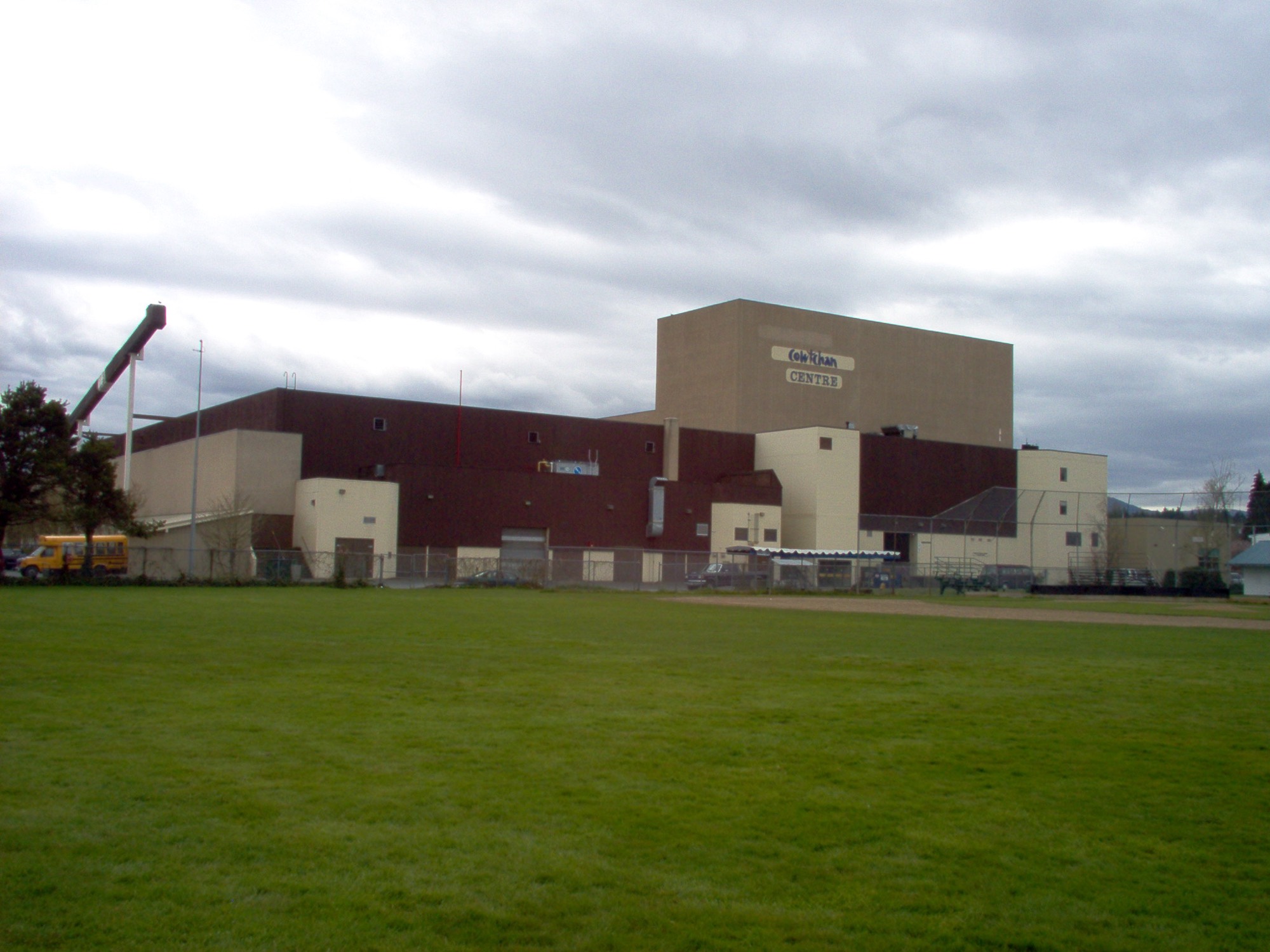
The existing stock is also aging. The CVRD plan notes that facilities such as curling rinks are likely to require significant reinvestment, and 2018 figures show roughly $15.3 million in combined annual facility requisitions across the regional system; those requisition figures are eight years old and must be updated before use in any financial comparison. requires validation[source: CVRD Regional Recreation Strategic Plan, Final Draft for Public Review, Sept 2025, citing 2018 requisitions] The region's largest indoor spectator venue, the Cowichan Community Centre in Duncan, was built in 1978 and holds 2,040 people (1,350 seated) on its arena floor. Large indoor events in the Cowichan Valley today depend on the dry floor of a 48-year-old ice arena.[source: CVRD, Cowichan Community Centre; Wikipedia, Cowichan Community Centre] Champions' planned spectator seating of approximately 1,000 around a premier competition court would be the region's first purpose-built court-sport spectator venue.
The CVSEEII framework names the Cowichan Community Centre and the Cowichan Sportsplex as the region's major recreation assets and directs the master planning process to identify where existing facilities are over capacity.[source: CVSEEII framework] Its sports sections are structured as research questions rather than findings, and this plan treats them accordingly. Club counts, program waitlists, VIU demand, and SD79 usage commitments were not verifiable from public sources in this research pass and are carried as named validation items rather than claims. requires validation
6.4 Competitive landscape and pricing floor
On Vancouver Island, the nearest active sport tourism competitor is Nanaimo, which published a formal Sport Facility Inventory in May 2026. Its stock is capable but fragmented municipal infrastructure: two rinks with 401 and 158 stadium seats at the Nanaimo Ice Centre, and arenas, an indoor pool, two artificial turf fields, and tennis and pickleball courts distributed across Beban Park.[source: Tourism Nanaimo, Sport Facility Inventory, May 2026] No facility on Vancouver Island combines a multi-court gymnasium, turf, climbing, and integrated hospitality on one site.
The provincial benchmark for tournament hosting is Langley Events Centre on the Lower Mainland: 322,312 sq ft with a triple gymnasium seating 2,200 and a 5,276-seat arena bowl, host of BC provincial basketball and volleyball championships.[source: Langley Events Centre public facility data] At approximately 100,000 sq ft with three basketball courts, Champions would be roughly one third of LEC's scale. This plan draws the honest conclusion from that comparison rather than the flattering one. Champions is positioned for Island-tier and regional events, not head-to-head competition with LEC for the largest provincial championships. The ferry is the structural boundary in both directions: it protects Island demand from mainland facilities and it constrains how much mainland demand Champions can capture.
US destination complexes such as LakePoint, Spooky Nook, and IMG Academy appear in this plan only as design and hotel-integration references, not as demand or financial analogues. They serve metropolitan catchments and business models that do not transfer to a market of this size, and LakePoint's visitor and impact figures are the company's own statements rather than independent audits.[source: LakePoint Sports company statements; Sports Facilities Companies portfolio; Woodbine Development, Legacy Hotel at IMG Academy] Their transferable lessons, team-friendly hotel design, integrated food service, and phased hotel sizing, are applied in Sections 5 and 8.
The local pricing floor is set by published CVRD rental rates, effective September 1, 2025 through August 31, 2026.[source: CVRD, Cowichan Community Centre facility rental rates, 2025-26]
| CVRD rental category | Published rate |
|---|---|
| Arena dry floor, general | $68.85 / hr |
| Arena dry floor, non-profit and youth | $55.08 / hr |
| Ice, prime adult | $180.41 / hr |
| Ice, prime minor | $106.12 / hr |
| Multipurpose hall | $54.57 / hr |
| Medium rooms and dance studio | $31.11 / hr |
[source: CVRD facility rental rates, Sept 1, 2025 to Aug 31, 2026]
Every court-hour rate in the Section 11 revenue model is benchmarked against this rate card for local use and against the Victus Advisors market-tested benchmark of $80 USD per court-hour for comparable US facilities.[source: Victus Advisors, Prince William County Indoor Sports and Events Center Feasibility Study, 2024] Local community hours will clear below the US benchmark, and the model reflects that.
6.5 What comparable facilities actually earn
The most rigorous public evidence on multi-court facility economics is the 2024 Victus Advisors feasibility study for Prince William County, Virginia, which projected approximately $419,000 USD in stabilized Year 3 operating income before debt service for a larger facility, on detailed market-tested assumptions.[source: Victus Advisors, Prince William County Final Report, 2024] The same study documents that large publicly-oriented indoor sports centers, including Chicago's $63.5 million USD track and field center and Louisville's $60.1 million USD sports and learning center, are explicitly structured as subsidized community assets whose operations are carried by nonprofit owners.[source: Victus Advisors, Prince William County Final Report, 2024] Smaller private facilities report 10 to 20 percent margins at modest revenue scales, with utilization the dominant profitability driver.[source: Swift facility-management industry data, vendor-reported]
This plan adopts that evidence rather than arguing with it. The sports floor is modeled to operate near breakeven. Returns and resilience are carried by the hotel, events, food and beverage, and sponsorship, and community access is designed and funded through the Champions Fund. That is not a concession. It is the same structure the strongest community sports assets in North America already use, and it is the structure that matches the community-first commitment this project was founded on.
Two supporting economics apply at component level. Pickleball courts embedded in a host facility absorb the host's fixed-cost structure, which is precisely the position of the six-court program here; standalone pickleball viability typically requires 8 to 12 courts carrying their own overhead.[source: Racquet Sports Institute, economies of scale analysis] Climbing is treated as an embedded amenity feeding memberships and youth programming rather than a standalone profit engine: Canadian climbing gym supply grew 6.5 percent net in 2025, but operator traffic and revenue were flat or down at many existing gyms, with youth programs the consistent bright spot.[source: Climbing Business Journal, Gyms and Trends 2025]
6.6 Named validation items for the market case
- Drive-time population study: 60, 90, and 120 minute rings including ferry-connected markets. requires validation
- Local club counts, registration trends, and program waitlists across basketball, volleyball, soccer, and pickleball. requires validation
- VIU athletics and recreation demand, and SD79 usage commitments, converted to LOIs or MOUs where appropriate. requires validation
- Current BC Stats population projection tables to replace the directional 2046 figure. requires validation
- Updated CVRD facility requisition figures to replace the 2018 series. requires validation
- Regional pickleball study outcome, as recommended in the CVRD Regional Recreation Strategic Plan. requires validation
7 Sports Tourism and Event Strategy
7.1 The thesis: selling the months the Island cannot
Vancouver Island's visitor economy has a shape problem, and that shape is the core of the Champions event strategy. Regional hotel occupancy peaks at 88 percent in August and falls to 41 percent in January, a wider seasonal swing than BC overall at 82 and 52 percent.[source: Destination BC, Vancouver Island Regional Profile, March 2025, CoStar 2024 data] Tourism Cowichan's own MRDT renewal plan sets explicit performance targets for higher off-season occupancy and RevPAR.[source: Tourism Cowichan Society, Five-Year Strategic Business Plan, Nov 2021] Youth and amateur sport runs on the opposite calendar from leisure tourism. Basketball, volleyball, and indoor pickleball seasons run October through April, precisely the months the region's accommodation sector sits emptiest.
Champions Sports Grounds is therefore not positioned as another summer attraction competing for the region's strongest months. It is positioned as the Cowichan Valley's counter-seasonal demand engine, generating visitation in the months the existing tourism economy cannot fill on its own.
The regional economy is large enough to support the ambition. The Vancouver Island tourism region generated $3.2 billion in gross tourism spending in 2022, with 2,700 tourism businesses and 26,300 tourism employees.[source: Destination BC, Vancouver Island Regional Profile, March 2025] Cowichan is one of the Island's smallest accommodation sub-markets (the MRDT evidence and its currency caveat appear in Section 8.2).
The visitor base is a drive market. BC residents account for 50 percent of Island visitor nights, Alberta 14 percent, and Washington is the top international source at 4 percent.[source: Destination BC, Vancouver Island Regional Profile, 2023 data] The event strategy therefore targets BC and Pacific Northwest travel teams, not long-haul markets. National sector context supports the category: sport tourism in Canada was last measured at approximately $6.8 billion in annual visitor spending (2017, the best available pre-pandemic baseline), with BC holding 12 percent of sport tourism visits and the highest international share of sport tourism revenues in the country.[source: Sport Tourism Canada, TSRC and ITS tabulations] US industry data showing sports events as the top hotel room-night generator in 63 percent of surveyed destinations is cited as sector context only and is not transferred to Cowichan-scale projections.[source: Sports ETA, 2023 State of the Industry study, US context]
7.2 Event tiers sized to the actual building
Every tournament claim in this plan is sized to the real program: three full-size basketball courts including one premier competition court with approximately 1,000 spectator seats, six pickleball courts, one FIFA-standard outdoor turf field, and flexible event use of the premier court for concerts, conferences, and community gatherings. That capacity supports Island-tier and regional provincial events. It does not support mega-events, and this plan does not claim otherwise.
| Tier | Event types (modeled examples) | Sanctioning or owning body | Facility fit | Seasonal placement |
|---|---|---|---|---|
| Island school sport | SD79 and Island zone basketball and volleyball championships, school district jamborees | BC School Sports and member associations | 1 to 3 courts, weekday and weekend | Nov to Mar |
| Island and regional club | Club basketball and volleyball tournaments, league finals, futsal, turf soccer tournaments | Basketball BC, Volleyball BC, BC Soccer affiliated clubs and leagues | 3 courts or turf field, 2 to 3 day weekends | Oct to Apr (courts); spring and shoulder (turf) |
| BC age-group provincial and regional | Age-group provincial qualifiers, regional pickleball championships, Hosting BC eligible events | Provincial sport organizations under the viaSport umbrella; Pickleball BC | Premier court plus 2 courts, or 6 pickleball courts; spectator seating in use | Oct to Apr priority |
| Non-sport events | Concerts, conferences, graduations, trade and community events on the premier court floor | Promoters, institutions, community organizations | Premier court in flexible configuration | Year-round, scheduled around the sport calendar |
This event tier table is modeled. It represents the target event mix for planning purposes, not confirmed bookings or sanctioning commitments. requires validation
A note on terminology, applied deliberately throughout this plan. The sport tourism industry describes the organizations that own and sanction events, such as viaSport, provincial sport organizations, and national governing bodies, as event rights holders. In this document that industry term refers only to sport bodies and event owners. First Nations are rights holders and governments in the constitutional sense, and the two usages are never interchangeable and never share a category.
7.3 Event owners, sanctioning bodies, and Hosting BC alignment
British Columbia's amateur sport system runs through viaSport, the provincial agency that also administers Hosting BC, the province's sport event hosting grant program. Hosting BC funds events hosted in BC with grants ranging from roughly $1,000 up to $35,000 depending on event category, plus a major sport event stream of $25,000 to $150,000, and the current intake covers events from March 2026 to June 2027.[source: viaSport, Hosting BC program guidelines and current intake] Exact caps per category must be confirmed at bid time. requires validation Two disciplines apply to how this funding appears in the plan. First, Hosting BC grants are per-event operating support; they strengthen individual event economics and they are never capital. Second, grants follow successful bids, so the plan treats them as an alignment opportunity rather than a revenue assumption.
The bid pathway runs through relationships this project is structurally well placed to convene:
- viaSport and Hosting BC: event-level grant alignment for provincial, regional, and eligible national events hosted at the facility.
- Provincial sport organizations: Basketball BC, Volleyball BC, BC Soccer, and Pickleball BC own or sanction the provincial and age-group events the facility is sized for. Early engagement on facility specifications, officiating requirements, and hosting calendars is a pre-opening workstream.
- BC School Sports and Island zone associations: school championships are the most reliable early tournament inventory because they recur annually and travel within the Island.
- Tourism Cowichan: named here as the prospective bid partner. Tourism Cowichan is funded through a 2 percent MRDT with the CVRD as sole designated recipient, its strategy explicitly targets off-season occupancy and RevPAR, and its administrative funding is capped at $120,000 annually, meaning it has the mandate for event attraction but limited bidding capacity of its own.[source: Tourism Cowichan Society, 2022-2027 MRDT renewal plan] Champions supplies the venue and operational capacity; Tourism Cowichan supplies destination marketing alignment and MRDT-backed legitimacy in provincial bid processes. This is a convening relationship to be formalized, not an assumed commitment. requires validation
7.4 Room-night generation logic
Room nights are the currency of sport tourism, and this plan builds them bottom-up from team counts rather than asserting them top-down from economic impact studies. The industry norms are one room per four players or one room per team per night as a floor, with families adding rooms beyond the team block.[source: sport tourism industry practice documentation, Fastbreak and related operator sources] Average spend per sport tourism visit in Canada is approximately $302 CAD, rising to approximately $775 for US-based visitors, a figure the Bouncing Back study also expresses in CAD. Both figures are 2021-vintage, require inflation adjustment, and enter the financial model as flagged inputs only. requires validation[source: Sport Tourism Canada, Bouncing Back study, 2021]
The following illustrative scenario shows the generation logic at the scale of the actual building. It is modeled, it is not a forecast, and every input requires validation through the utilization study and event partner engagement.
| Modeled input (illustrative weekend tournament) | Court sports (3 courts) | Pickleball regional (6 courts) |
|---|---|---|
| Teams or entrants | 16 to 24 teams | 120 to 200 players |
| Share travelling from outside day-trip range | 50 to 60% | 40 to 60% |
| Nights per travelling participant | 1 to 2 | 1 to 2 |
| Rooms per travelling team or per 4 players | 3 to 6 per team | 1 per 2 to 4 players |
| Indicative room nights per event | 60 to 180 | 40 to 120 |
| Family and spectator rooms | Not counted; upside only | Not counted; upside only |
This table is modeled and illustrative. Ranges reflect the absence of validated local event data; no figure in it is a commitment or forecast. The indicative room-night ranges reflect mid-band combinations of the inputs rather than minimum-input arithmetic; the arithmetic floor of the stated minima is lower than the low end shown. Annual room-night totals depend on the number of hosted event weekends, which is set in the Section 10 utilization plan and constrained by the programming conflict policy protecting community access hours. requires validation
Three structural observations complete the logic. First, at 16 to 24 teams per weekend, a three-court facility generates meaningful but not transformational room-night volume per event; the strategy compounds through frequency across a 26-week indoor season rather than through single large events. Second, room nights generated in October through April land in the exact trough Destination BC's data identifies, which is what makes them disproportionately valuable to local accommodation operators and to Tourism Cowichan's stated targets. Third, constrained supply in the Island's anchor hotel market strengthens capture (Section 8.2), pending the Cowichan-specific hotel market study.
7.5 Stay-to-play: evaluated, not assumed
Stay-to-play policies, under which tournament entry is linked to booking within designated hotel blocks, are an established mechanism for guaranteeing room blocks, evidencing economic impact, and supporting hosting grant applications, with block rates ideally 15 to 20 percent below public weekend pricing.[source: sport tourism operator documentation] The model is also increasingly contested. Documented abuses in the US, including blocks priced above market and opt-out fees of $500 to $2,400, prompted a May 2026 US federal bill proposing a ban.[source: Oklahoma Watch investigation, March 2025; US legislative reporting, May 2026]
This plan's position follows directly. Stay-to-play is evaluated as one tool among several, never assumed as the revenue mechanism. If adopted for specific events, the policy will be transparent and family-fair: block rates at or below market, no opt-out fees, published terms, and no hidden rebates. A tournament venue built on a community-first foundation cannot fund itself by squeezing the families it exists to serve. The room-night model in this plan does not depend on stay-to-play compliance rates. requires validation
7.6 What the event strategy does not claim
For clarity of underwriting, the following are outside this strategy. The facility does not compete for the largest provincial championships hosted at Langley Events Centre scale. It does not project US destination-complex visitation, and no LakePoint, Spooky Nook, or IMG figure appears in any demand or revenue calculation in this plan. It does not assume sanctioning commitments that have not been negotiated, hosting grants that have not been awarded, or an event calendar that has not cleared the community-access programming policy in Section 10. The event strategy earns its numbers through the utilization study, partner LOIs, and the hotel market study, and it is presented here as a modeled framework awaiting exactly that validation.
8 Hotel Market and Feasibility Framework
8.1 The role of the hotel in the investment case
In this plan the hotel is not an amenity attached to a sports facility. It is a core business unit, and it is the component of Champions Sports Grounds most likely to support conventional financing. The evidence assembled elsewhere in this document points to a consistent sector pattern: large multi-court sports venues operate near breakeven or as deliberately subsidized community assets, while the hospitality, events, and food and beverage lines around them carry the economics.[source: Victus Advisors, Prince William County Indoor Sports and Events Center Feasibility Study, 2024] The hotel is therefore treated throughout this plan as its own entity, with its own market study, its own capital stack, and its own debt capacity, evaluated separately from the sports facility (see Sections 13, 14, and 17).
That separation imposes a discipline on this section. A hotel entity that is expected to carry debt must be sized and underwritten from market evidence, not from enthusiasm about the venue next door. This section sets out what the regional evidence supports, what it does not yet support, and the professional study that must close the gap before any room count is fixed.
This plan does not fix a room count. It presents 80, 100, and 120 rooms as scenarios, with 80 rooms as the operator base case, and it names an independent hotel market and feasibility study as a hard gate that must close before the room count, brand strategy, or debt sizing is decided.
8.2 What the market evidence shows, and what it does not
The regional accommodation market is measurable at the Vancouver Island level and healthy by national standards. Vancouver Island hotels ran 68% occupancy at a $263 average daily rate in 2024, up from 67% and $237 in 2022.[source: Destination BC, Vancouver Island Regional Tourism Profile, 2025, citing CoStar] British Columbia posted the strongest provincial hotel performance in Canada in 2025 at 70.4% occupancy, $257.03 ADR, and $180.92 RevPAR, against a national occupancy average of 66.1%.[source: CoStar/STR, Canada year-end hotel performance release, 2025] The Island's tourism economy generated $3.2 billion in gross visitor spending in 2022, roughly 18% of BC's overnight total, and accommodation is the single largest visitor spending category at 29%.[source: Destination BC, Vancouver Island Regional Tourism Profile, 2025]
The demand base is a drive market. BC residents account for 50% of Island visitor nights, Alberta 14%, Ontario 8%, and Washington State, at 4%, is the largest international source.[source: Destination BC, Vancouver Island Regional Tourism Profile, 2025] That profile matters for a tournament-anchored hotel: the guest this property serves arrives by vehicle or short ferry crossing with a team, a family, and equipment, not by long-haul flight.
Two further regional signals are relevant. First, the Cowichan Valley itself is one of the smallest accommodation sub-markets on the Island, with MRDT room revenues of approximately $20.9 million in 2019, roughly one tenth of Victoria's $205 million in the same period. The series is dated and the current BC Stats MRDT tabulation must be pulled before publication. requires validation[source: Tourism Cowichan Society, Five-Year Strategic Business Plan, 2021, citing BC Stats MRDT tabulations] Second, Greater Victoria, the Island's anchor hotel market, faces an estimated shortage of at least 2,000 hotel rooms over the coming decade according to an April 2026 industry working group report. Constrained supply in the anchor market is a supportive signal for a purpose-built property up-Island, but it is inference, not evidence of Cowichan demand, until a local study confirms it. requires validation[source: Vancouver Island Free Daily, report of Victoria hotel working group, April 2026]
The evidence has a hard limit. No public Cowichan-specific or Duncan-specific hotel occupancy or ADR series was found in the research for this plan. Every occupancy and rate figure cited above is regional, and regional figures blend Victoria's urban market and Tofino's resort market with small-market conditions that will differ materially. The absence of submarket performance data is itself a finding, and it is the single strongest argument for commissioning the feasibility study named in Section 8.7 before any room count, flag conversation, or debt model is advanced. requires validation
The CVSEEII framework adds a framing obligation rather than a market number: it directs that visitor accommodation in the Valley be evaluated through a housing and community benefit lens, so that accommodation demand strengthens rather than strains the residential housing base.[source: CVSEEII framework] A purpose-built hotel serving visiting teams is aligned with that direction, because it houses visitors in dedicated visitor inventory instead of displacing long-term rental stock into short-term use.
8.3 Seasonality is the thesis, not a footnote
The Island's seasonal swing and Tourism Cowichan's off-season targets are documented in Section 7.1; this section draws the hotel consequence.
This is where the sports campus and the hotel become one investment logic. Indoor tournament and event demand is strongest precisely when leisure demand is weakest: league play, club tournaments, and provincial age-group events concentrate in the September to April window. A hotel beside three basketball courts, six pickleball courts, and a FIFA-standard turf field is positioned to sell room nights in the months when the rest of the Island's inventory sits at 41% to 55% occupancy. The hotel does not merely benefit from the venue. The venue exists, in commercial terms, to give the hotel a winter.
The discipline that follows: every scenario in this section must be stress-tested against the winter floor, not the summer peak. The downside case in Table 8.2 anchors winter months to the Island's 41% January trough on the assumption that tournament demand fails to materialize, because that is the case a lender will price. Tourism Cowichan is identified as a prospective bid and marketing partner for counter-seasonal events, subject to its own decision processes.
8.4 Comparable campus hotels: design lessons, not demand analogues
Three North American sports-campus hotels inform the design of this hotel. None of them validates its market. LakePoint sits beside metro Atlanta, Spooky Nook operates a building roughly seven times the Champions indoor program in the US northeast corridor, and IMG Academy is a tuition-driven boarding academy. Their visitor and impact figures are company statements, not audited results, and they are excluded from all demand and revenue modeling in this plan. What transfers is how they integrated hospitality with sport, and in one important case, how carefully they sequenced room count.
| Comparable | Hotel configuration | Transferable lesson for Champions |
|---|---|---|
| LakePoint Sports, Georgia | 114-room Element by Westin on campus; a $39M, 200-room second hotel announced only after years of proven operation[source: LakePoint Sports announcement of 200-room hotel and infrastructure expansion] | Sequencing. A 1,300-acre campus with a 12-court indoor centre opened with 114 keys and expanded only after demand was demonstrated. This is the strongest available argument for entering at the 80-room end of the scenario band and designing for expansion, not building for the bull case on day one. |
| Spooky Nook Sports, Pennsylvania | Warehouse Hotel physically attached to the complex, with integrated event and meeting space[source: Sports Facilities Companies, Spooky Nook portfolio profile] | Integration. Direct indoor connection between rooms, courts, food service, and meeting space is what converts a tournament venue into a weekend destination for teams and families. The hotel should be planned into the campus circulation from the start, not added beside it. |
| IMG Academy, Florida | Legacy Hotel: 150 rooms, five storeys, select service, 5,060 sq ft of meeting space, opened 2018[source: Woodbine Development, Legacy Hotel at IMG Academy project profile] | Program. A select-service format with meaningful meeting space, sized at 150 keys against a demand generator far larger than Cowichan's, confirms the amenity set (team meals, meeting rooms, family-friendly rooms) and cautions against exceeding the scenario band here. |
Read together, the comps argue for restraint. Every one of these properties serves a demand generator many times the scale of a three-court, six-pickleball-court campus in a region of roughly 89,000 residents. The comp set justifies the hotel format. It does not justify a large hotel.
8.5 Room count scenarios: 80 / 100 / 120
Per the project brief, three room-count scenarios are carried forward for testing by the feasibility study. The 80-room scenario is the operator base case, on the LakePoint sequencing logic and on the fact that no submarket performance data yet exists. The 100-room and 120-room scenarios are upside cases that become credible only if the market study evidences deeper demand, stronger regional compression from the Victoria supply shortage, or committed institutional demand (for example, hospital-related and corporate travel from the new Cowichan District Hospital anchor). All figures in Table 8.2 are modeled placeholders for illustration of scenario mechanics. None is a projection, none is guaranteed, and every one is superseded by the feasibility study when it reports.
| Scenario parameter (modeled, illustrative only, CAD) | Scenario A: 80 rooms (base case) | Scenario B: 100 rooms | Scenario C: 120 rooms |
|---|---|---|---|
| Annual available room nights | 29,200 | 36,500 | 43,800 |
| Stabilized occupancy placeholder band requires validation | 58% to 65% | 55% to 63% | 52% to 60% |
| ADR placeholder band, discounted from the 2024 Island regional ADR of $263 to reflect a small, unproven submarket requires validation | $170 to $210 | $170 to $210 | $165 to $205 |
| Downside winter case: November to February occupancy anchored to the Island's 41% January floor, assuming tournament demand does not materialize requires validation | 41% winter months | 41% winter months | 41% winter months |
| Demand thesis that must be evidenced for the scenario to stand | Local, tournament, and hospital-anchor demand at conservative capture | Base case demand plus demonstrated regional compression and event calendar depth | All of Scenario B plus committed group and extended-stay contracts |
Table 8.2 is deliberately mechanical. Its purpose is to show how the scenarios will be evaluated, not to assert performance. The occupancy and ADR bands are modeled placeholders set below regional averages because the regional averages include markets this property will not resemble, and because a new hotel in a submarket with no published performance record earns no benefit of the doubt. All scenario figures are modeled, not guaranteed, and subject to the feasibility study and final documentation. requires validation
Tournament room-night demand, when modeled by the feasibility consultant, should be sized honestly to the venue: three basketball courts and six pickleball courts hosting Island-tier and BC regional events, not a LakePoint-scale calendar. Canadian sport tourism spend benchmarks and their inflation caveats are set out in Section 7.4 and enter the study as flagged inputs only.
On financing posture: the hotel is the only component of Champions Sports Grounds presented as conventionally debt-capable, and only subject to the feasibility study. Debt sizing in the integrated financial model targets a minimum debt service coverage of 1.25x to 1.40x on stabilized modeled net operating income, stress-tested at plus 200 basis points of interest rate and minus 10 points of occupancy, with an FF&E reserve of 4% of rooms revenue carried as an industry-standard assumption. All of these are modeled underwriting parameters, not commitments, and no hotel revenue in this plan is presented as bankable before the feasibility study reports. requires validation Sections 14 through 17 keep the hotel capital stack fully separate from the sports facility, which is not underwritten to carry senior debt.
8.6 A team-friendly hotel program
Whatever the final key count, the program is fixed by the guest. This property serves teams, families travelling with athletes, coaches and officials, event organizers, and, in the shoulder seasons, hospital-related, corporate, and leisure travellers. The design program carried into the feasibility study and subsequent concept design includes:
- A room mix weighted to double-queen rooms and family suites, with a defined block of extended-stay units for medical, project, and relocation demand tied to the hospital anchor
- Group check-in capability and team arrival handling, including bus loading, staging, and secure equipment storage
- Team meeting rooms and film-review space, complementing the venue's theatre-style strategy room
- Group dining capacity and team meal service, integrated with the campus food hall rather than duplicating it
- Guest and team laundry adequate to tournament turnover
- Recovery-oriented amenities aligned with the campus sports medicine and therapy centre
- A direct, weather-protected pedestrian connection to the indoor facility
- Accessible rooms and family-inclusive design consistent with the community-first positioning
These features are not decoration. They are the operating difference between a hotel that happens to be near a venue and a hotel that teams book as part of the event itself, and they are the transferable core of the LakePoint, Spooky Nook, and IMG precedents.
8.7 Stay-to-play: evaluated, not assumed
The full stay-to-play position, including the industry norms, the documented abuses, and the transparent, family-fair policy conditions under which it could ever be adopted, is set out once, in Section 7.5, and governs this section. What matters here is the underwriting consequence: the feasibility study is directed to model hotel demand both with and without a stay-to-play policy, and to add no undisclosed rebate structure between the venue and the hotel entity, so that the room count is never dependent on a booking mechanism the market or regulators may reject. Champions Sports Grounds does not need that reputation, and its community-first positioning cannot survive it.
8.8 What the hotel feasibility study must determine
An independent, professionally conducted hotel market and feasibility study is a named condition precedent in this plan. It follows site control and servicing confirmation (Sections 4 and 20) and precedes any fixed room count, brand or flag discussion, operator selection, or debt sizing. Its scope, at minimum:
- Submarket supply and performance: a defined Cowichan competitive set with STR or CoStar submarket occupancy, ADR, and RevPAR data, closing the gap that public sources cannot, including monthly seasonality curves
- Demand ring analysis: drive-time demand mapping for the local, Island, BC mainland, and Pacific Northwest markets, segmented by leisure, group and tournament, corporate, and hospital-related demand
- Induced demand modeling: defensible tournament and event room-night projections sized to the actual venue program of three basketball courts, six pickleball courts, and one turf field, under realistic event calendars, with and without stay-to-play
- Anchor demand verification: interviews and, where possible, letters of intent covering Island Health and hospital-related travel, VIU, SD79, sport organizations, and event owners and sanctioning bodies
- Room count recommendation: a supported recommendation within or outside the 80/100/120 band, with a phasing option analysis reflecting the LakePoint sequencing precedent
- Positioning and rate strategy: chain scale, brand versus independent economics, achievable ADR by segment and season, and the discount structure for team blocks
- Facilities program confirmation: room mix, extended-stay component, meeting space, and food and beverage interface with the campus food hall
- Operating projections: a ten-year operating pro forma with a realistic ramp period, staffing ratios per key, an FF&E reserve, and management structure options (franchise, third-party manager, or independent)
- Financing parameters: supportable debt at 1.25x to 1.40x coverage on stabilized modeled NOI, stress cases at plus 200 basis points and minus 10 points of occupancy, and sensitivity of the capital stack to each room-count scenario
- Downside definition: explicit modeling of the no-tournament winter case anchored at the regional 41% January floor, and the minimum demand conditions under which the hotel should not proceed
- Alignment screening: confirmation that the accommodation strategy holds up under the CVSEEII housing and community benefit lens, adding visitor capacity without drawing down residential housing stock[source: CVSEEII framework]
Until this study reports, every hotel figure in this document is a modeled placeholder. The plan's credibility rests on saying so, and on refusing to fix a room count before the market has been asked.
9 Customer Segments
Champions Sports Grounds serves a layered market. The layers are not equal in revenue, and they are not equal in purpose. The plan treats them separately so that the community-first commitment and the commercial engine can each be seen, measured, and held accountable.
A protocol note governs this entire section. First Nations are rights holders and governments. They do not appear in this or any customer segmentation, and this plan does not model demand from Nation communities. Any programming, access arrangement, or economic participation involving a Nation would be shaped by that Nation, through its own processes, before concepts are fixed. Nothing in the segments below implies any Nation's interest or position.
9.1 Local and regional segments (the base load)
- Adults and seniors, daytime. The Cowichan region's demand profile skews older: median age 49.9, with 24 percent of residents aged 65 and over.[source: CVRD Regional Recreation Strategic Plan, final draft Sept 2025] Daytime pickleball, the walking track, and seniors fitness are core utilization for this facility, not filler. Pickleball demand is regional government-acknowledged: the CVRD's own recreation plan flags pickleball as an emerging demand pressure and calls for a regional pickleball study.[source: CVRD Regional Recreation Strategic Plan] The national participation evidence is in Section 6.3.
- Youth and families. Soccer and basketball are the top organized sports for Canadian youth, with 39 percent of youth in organized soccer and 31 percent in organized basketball (consistent with Section 6.2).[source: Jumpstart State of Youth Sport in Canada, 2025] Regionally there is no dedicated multi-court gymnasium in the CVRD's published facility inventory, an observed omission from the region's own document.[source: CVRD Regional Recreation Strategic Plan] Local club counts, registration volumes, and waitlists were not verifiable in this research pass and are named validation items requires validation.
- Schools (SD79). School District 79 enrolment is approximately 7,943 FTE and has grown for three consecutive years, supporting school-hours programming and school-sport tournament demand.[source: BC Ministry of Education operating grant records, Feb 2025 count; SD79 district news] Usage commitments from SD79 are not yet secured and are treated as a partnership conversion item requires validation.
- Members (fitness, track, climbing, dance). A recurring-revenue membership base across the strength and performance gym, mezzanine track, climbing area, and dance studio. Climbing is positioned as an embedded amenity feeding memberships and youth programming rather than a standalone bet, consistent with the climbing-segment evidence in Section 6.5. Membership capture rates for this market are unmodeled pending a utilization study requires validation.
- Champions Fund access participants. Children, families, and individuals who would otherwise be excluded because of cost. This is a designed segment, not a residual one: 26 percent of surveyed Cowichan residents cite program cost as a participation barrier.[source: CVRD Regional Recreation Strategic Plan resident survey] Access hours for this segment are protected in the programming policy in Section 10 and funded through the Champions Fund, with flows shown separately in Section 11.
- Post-secondary and institutional users. VIU program demand, sports medicine referral flows connected to the new Cowichan District Hospital ecosystem, and community organization bookings. The CVSEEII framework frames the complex as a potential regional wellness and community infrastructure node supporting youth, families, seniors, athletes, events, health, tourism, and local enterprise.[source: CVSEEII framework] VIU demand and institutional commitments are unverified requires validation.
9.2 Visitor segments (the counter-seasonal engine)
- Visiting teams, clubs, and tournament organizers. Sized honestly to the program: 3 basketball courts and 6 pickleball courts support Island school and club championships, BC age-group events, and pickleball regionals, not national multi-bracket events. The realistic catchment is BC and Pacific Northwest drive markets: BC residents account for 50 percent of Island visitor nights, Alberta 14 percent, with Washington the top international source at 4 percent.[source: Destination BC Regional Profile, Vancouver Island, 2025] Spend benchmarks and their vintage caveats are per Section 7.4.
- Event and conference clients. Concerts, graduations, conferences, trade shows, and private events on the premier court floor. The Victus Advisors benchmark for a comparable venue type prices graduations at $20,000 per day.[source: Victus Advisors, Prince William County feasibility study, 2024]
- Hotel guests. Teams, families, event attendees, hospital-related travel, and leisure visitors. The hotel is a separate business unit with its own market study gate (Section 8); no room count is fixed and no hotel demand is presented as bankable before that study reports.
- Sponsors and naming partners. Regional businesses and institutions purchasing facility and component naming rights. The documented buyer pattern for venues of this type is regional health systems, which is directly relevant given the new Cowichan District Hospital and Island Health's regional presence.[source: Victus Advisors, 13-deal naming-rights sample, 2024] No sponsor conversations are assumed; this is prospective inventory.
9.3 What this segmentation still needs
The demand evidence for local segments is structural (inventory gaps, demographics, provincial participation trends) rather than transactional. Before the financial model is finalized, the following are named validation items: club counts and waitlists by sport, SD79 usage commitments, VIU program demand, a drive-time population and demand-ring study, and a membership willingness-to-pay survey. Each appears in the revenue model in Section 11 with a marker requires validation.
10 Programming and Utilization Plan
Utilization is the single largest driver of this facility's economics. Small private facilities live or die on it, and larger public venues that ignore it become permanent subsidy cases.[source: Swift facility-management operational data; Victus Advisors, 2024] The programming plan therefore starts from the honest shape of local demand, not from an aspiration of full courts.
10.1 The programming logic
The demand that actually fits this market runs in two interlocking patterns. Daytime belongs to adults and seniors: pickleball, track walking, fitness, therapy, and school-hours bookings. Evenings and weekends belong to youth sport, club training, leagues, and members. Tournament weekends, concentrated in the October-to-March trough, belong to visiting teams. The facility is programmed as one instrument playing all three parts, not as a tournament venue with community hours attached.
The seasonal logic set out in Sections 7 and 8 governs programming: Champions concentrates tournament and event programming in the months the visitor economy goes quiet, with Tourism Cowichan as a named prospective bid partner.
10.2 Seasonal and daypart utilization grid (modeled)
This grid is the modeled scaffold for the revenue build in Section 11. Every percentage is an assumption pending an hour-by-hour utilization study requires validation.
| Space | Weekday day (8:00-17:00) | Weekday prime (17:00-22:00) | Weekend (non-event) | Tournament weekends |
|---|---|---|---|---|
| Basketball courts (3) | Schools, adult daytime leagues, camps; modeled 25-40% sold | Club training, leagues, rentals; modeled 70-85% sold | Leagues, rentals, birthday and group bookings; modeled 40-60% sold | Full-facility event mode, 12-18 event days/yr modeled |
| Pickleball courts (6) | Prime time for this market: seniors and adult drop-in, leagues, clinics; modeled 40-55% sold | Mixed leagues and open play; modeled 30-45% sold | Open play, clinics, ladders; modeled 30-45% sold | Minimum 2 courts protected for community play except during sanctioned pickleball events |
| Climbing and bouldering | School groups, homeschool blocks, seniors intro | Youth programs, member peak | Member and day-pass peak | Open (not event-dependent) |
| Track, fitness, dance studio | Seniors fitness, walking club, rehab adjacency | Member peak, classes | Classes, rentals | Open (member guarantee applies) |
| Outdoor turf field | School and community use (seasonal) | Club soccer, rentals (seasonal) | League play, rentals | Multi-sport event overlay where scheduled |
| Premier court (event mode) | Concerts, conferences, graduations, community gatherings; modeled 6-12 non-sport event days/yr, booked to avoid peak sport season conflicts | |||
10.3 Event calendar tiers
Event ambition is sized to the physical program: 3 basketball courts convertible for volleyball, and 6 pickleball courts. The realistic tiers are:
- Tier 1, Island school and club championships. SD79 and Island zone events, club invitationals. Highest frequency, modest room nights.
- Tier 2, BC age-group and regional events. BC age-group basketball and volleyball, pickleball regionals. These are the counter-seasonal room-night drivers.
- Tier 3, Hosting BC eligible provincial events. viaSport's Hosting BC program funds sport events in BC with grants of roughly $1,000 to $35,000 depending on category; caps must be confirmed at bid time requires validation.[source: viaSport Hosting BC guidelines]
Stay-to-play is evaluated, not assumed, under the transparent, family-fair policy set out in Section 7.5; no room-night or revenue figure in this plan depends on it.
10.4 Programming conflict matrix and priority policy
A community-first facility that quietly displaces its community on every profitable weekend is not community-first. The conflict policy is therefore explicit, and it is a board-adopted commitment, not an operational preference. The matrix below is draft policy for adoption at the governance formation gate, not a modeled projection.
| Conflict | Priority rule |
|---|---|
| Tournament weekend vs member access | Member guarantee: fitness gym, track, climbing, and dance studio remain open to members on all event days. Court-dependent member bookings are rescheduled with priority rebooking. |
| Tournament weekend vs Champions Fund access hours | Fund access hours displaced by an event are rescheduled within the same week, never cancelled. The weekly floor (below) is measured net of displacement. |
| Tournament weekend vs pickleball community play | Minimum 2 of 6 pickleball courts remain in community play on basketball and volleyball event days. Exception: sanctioned pickleball events using all courts. |
| Concert or conference use of premier court vs sport season | Non-sport events are booked outside peak court-sport season (October to March) except where a full-facility blackout is approved by the board. |
| School daytime bookings vs adult daytime programming | Scheduled by term with SD79; adult daytime programming holds protected blocks on pickleball courts and track. |
- Community-access floor: a minimum of 20 hours per week of Champions Fund subsidized access, facility-wide, protected in all 52 weeks including event weeks. (Draft policy figure for board adoption requires validation.)
- Full-facility blackout cap: no more than 16 full-facility event weekends per year, so that tournament success cannot silently consume the community mandate requires validation.
10.5 Ramp-up
Utilization is modeled with a three-year ramp, not a hockey stick. Year 1 opens with local programming, memberships, and Tier 1 events only. Year 2 adds Tier 2 regional events and league maturation. Year 3 reaches the stabilized grid above. The ramp carries operating losses through Year 3, with Year 3 approaching but not yet reaching breakeven; the losses are funded through working capital raised in advance, and this is stated plainly in Sections 11 and 12 and reflected in the integrated model in Section 15.
11 Revenue Model
Modeled stabilized facility revenue of $1.4 million to $2.7 million positions the sports floor near breakeven by design, with returns carried by the hotel entity, events, food and beverage, and sponsorship. Every figure in this section is modeled. None is guaranteed, and every line carries its assumption and its validation status.
11.1 The honest starting point on facility economics
The sector evidence (Section 6.5) shows comparable venues operate near breakeven or as deliberately subsidized community assets. Champions adopts that framing deliberately: the sports floor operates near breakeven, community access is a designed outcome funded through the Champions Fund, and returns are carried by the hotel entity, events, food and beverage, and sponsorship. This is not a weakness of the plan. It is the plan.
The prior workbook contained one populated revenue schedule, basketball at approximately $546,950 per year, and the blueprint's own finding is that this schedule is not investment-grade. That figure is treated here as a superseded artifact, shown only for reconciliation, and it does not serve as a baseline anywhere in this plan.
11.2 Rebuilding the basketball line from the bottom up
The pricing floor is local and published: CVRD arena dry floor rents at $68.85 per hour general and $55.08 per hour non-profit and youth; the multipurpose hall rents at $54.57 per hour.[source: CVRD facility rental rates, Sept 2025 to Aug 2026] The market-tested benchmark for purpose-built court space is $80 USD per court-hour with tournament rentals of $8,500 to $12,000 USD per day per facility side at a larger US venue.[source: Victus Advisors, 2024] Local hours will clear at or below the CVRD comparables; only event and premium hours approach the Victus rate.
| Modeled stabilized (Year 3) court revenue build, 3 basketball courts. All lines modeled, CAD requires validation | |||||
|---|---|---|---|---|---|
| Block | Capacity (court-hrs/yr) | Modeled sold | Sold court-hrs | Modeled rate ($/court-hr) | Modeled revenue |
| Weekday prime (17:00-22:00, 48 wks) | 3,600 | 70-85% | 2,520-3,060 | $60-70 blended (youth mix below CVRD adult rate) | $151,000-$214,000 |
| Weekday daytime (8:00-17:00, 48 wks) | 6,480 | 25-40% | 1,620-2,590 | $40-55 (school and daytime rates) | $65,000-$143,000 |
| Weekends, non-event (approx. 35 weekends) | 2,100 | 40-60% | 840-1,260 | $55-70 | $46,000-$88,000 |
| Tournament and event days (12-18 days/yr) | n/a (day rate) | n/a | n/a | $4,000-7,500/day full facility (scaled from Victus per-side rates to a 3-court program) | $48,000-$135,000 |
| Modeled stabilized total | Implied paid utilization: roughly 4,980-6,910 court-hours per year, or 4.5 to 6.3 paid hours per court per day equivalent | $310,000-$580,000 | |||
The reconciliation is now visible. The superseded workbook figure of $546,950 sits near the top of this modeled range, which means it silently assumed near-full prime utilization at above-local rates, year-round, with no ramp and no dead zones. The modeled base case for planning purposes is the lower-middle of the range, approximately $350,000 to $450,000 at stabilization requires validation, reached only in Year 3 after a two-year ramp.
11.3 Full revenue stream model
Every revenue stream in the program is modeled below. Ranges are deliberate; false precision is the enemy of credibility. Hotel revenue is scenario-banded and gated on the independent market study named in Section 8; it is shown here for completeness and is not presented as bankable.
| Modeled stabilized (Year 3) revenue by stream, CAD unless labeled USD. Every line modeled, not guaranteed, subject to final documentation | |||
|---|---|---|---|
| Stream | Basis | Modeled assumption (stabilized) | Source / status |
| Basketball / multi-court rentals and leagues | Court-hours × rate, per utilization grid (11.2) | $310,000-$580,000; base case $350,000-$450,000 | CVRD rate card; Victus $80/court-hr benchmark requires validation |
| Pickleball (6 courts): drop-in, leagues, clinics, court bookings | Court-hours × blended rate; daytime-weighted | 17,280 court-hr capacity at 8 programmed hrs/day; 30-45% paid at $28-40/hr blended: $145,000-$310,000. Courts ride the host facility's fixed-cost structure; standalone pickleball economics do not apply | Pickleball Canada participation data; Racquet Sports Institute scale analysis (qualitative); rates unvalidated requires validation |
| Tournament and event hosting (incremental: entry fees, hosting fees, grants) | Per-event economics on 12-18 event days across Tiers 1-3 | $40,000-$120,000 including Hosting BC grants of $1,000-$35,000 per eligible event | viaSport Hosting BC guidelines requires validation |
| Memberships (fitness, track, climbing, dance access) | Members × blended monthly rate | 700-1,200 members at $45-65/month blended: $378,000-$936,000. Capture rate unstudied; widest range in the model | No local comparable; willingness-to-pay survey named as validation gate requires validation |
| Climbing day passes and youth programs | Day-pass volume + program enrolment (climbing is an embedded amenity, not a standalone bet) | $60,000-$150,000; youth programs are the documented segment bright spot | Climbing Business Journal 2025 (flat operator traffic noted) requires validation |
| Programs, camps, and clinics (all sports) | Enrolment × fee; program expenses modeled at ~70% of program revenue per Victus | Gross $150,000-$300,000; net contribution $45,000-$90,000 | Victus expense benchmark requires validation |
| Sports medicine and therapy centre | Leased to clinical operator (base case): area × NNN rate | 2,000-4,000 sq ft at $25-35/sq ft: $50,000-$140,000 lease income | Modeled; no local clinical-lease comparable pulled requires validation |
| Food and beverage (food hall, coffee bar, sports lounge, event concessions) | Footfall-driven gross sales; margin capped at 30-35% per Victus | Gross $300,000-$650,000; net contribution $90,000-$230,000, concentrated on event days | Victus concession margin benchmark requires validation |
| Non-sport events on premier court (concerts, conferences, graduations, private events) | Day rate × 6-12 event days/yr | $8,000-$20,000/day: $48,000-$240,000 (Victus benchmarks graduations at $20,000/day) | Victus 2024 requires validation |
| Media, recording, and livestream services | Studio hire, stream packages for clubs and events | $10,000-$40,000; treated as service differentiation, not a material line | Modeled, no benchmark requires validation |
| Dance studio rentals (non-member external hire) | Hours × rate benchmarked to CVRD dance studio at $31.11/hr | $15,000-$45,000 | CVRD rate card requires validation |
| Outdoor turf field rentals | Field-hours × rate, seasonal | $40,000-$110,000; benchmarked against CVRD synthetic turf comparables to be pulled | Rate comparable not yet pulled requires validation |
| Sponsorship and naming rights | Facility naming + component naming (courts, climbing wall, track, lounge) to multiply inventory | Facility-level $128,000-$160,000 USD/yr benchmarked to the Victus 13-deal sample (median $128,000 USD/yr, health systems the recurring buyer, relevant given the new Cowichan District Hospital); Canadian community precedents $50,000-$100,000 CAD/yr; total program $130,000-$260,000 CAD/yr, consistent with Sections 15 and 16 | Victus 2024 naming-rights sample requires validation |
| Hotel (separate entity; see Section 8) | Keys × occupancy × ADR; 80-room base case, 100/120 as upside scenarios only | Illustrative band only: 80 keys at the Section 8 placeholder bands of 58-65% occupancy and $170-210 ADR implies $2.9M-$4.0M rooms revenue. No Cowichan-specific occupancy or ADR series exists; regional 2024 figures are 68% occupancy and $263 ADR with a 41% January trough | Destination BC / CoStar regional data; independent hotel market study is a hard gate before any figure is bankable requires validation |
Modeled stabilized facility revenue, excluding the hotel entity, sums to an indicative range of roughly $1.4 million to $2.7 million requires validation. The top of that range deliberately does not sum the line maxima, which would exceed $3 million: the streams will not all peak simultaneously, so the floor of the range sits close to the sum of the line minima while the ceiling reflects strong performance across lines without stacking every top figure. Against Victus-grade operating expenses (Section 12), this positions facility operations near breakeven at the midpoint and in deficit at the low end. Both outcomes are shown in the integrated model and sensitivity analysis (Sections 15 and 16).
11.4 Cross-subsidy structure and who funds shortfalls
- The carrying lines. Hotel operations (post-study, if confirmed), non-sport events, food and beverage, and sponsorship are the lines expected to carry the sports floor and fund community outcomes. The facility P&L, hotel P&L, and Champions Fund flows are presented separately throughout this plan so the cross-subsidy is visible, not blended away.
- Years 1-3. The model carries a three-year ramp with operating losses in Years 1 and 2 and a smaller Year 3 deficit as operations approach breakeven. These losses are funded from working capital raised as part of the capital plan, not from the Champions Fund and not from assumed grants. The working capital requirement is sized in Section 15.
- The scenario where cross-subsidy falls short. If hotel confirmation fails or event revenue underperforms, the facility requires an ongoing operating subsidy, consistent with the Chicago and Louisville precedents of subsidized community assets.[source: Victus Advisors, 2024] Section 16 models this scenario explicitly, and Section 17 presents the funding landscape for it. Section 16 carries it in full view.
- Champions Fund. The Fund is a nonprofit access mechanism, not an operating revenue line. Its inflows (philanthropy, designated sponsorship, a defined share of event proceeds) and outflows (subsidized access hours, fee waivers, equipment support) are reported separately and never used to cover operating deficits.
All financial figures in this section are modeled, are not guaranteed, and are subject to final documentation, QS costing, hotel feasibility, and utilization studies.
12 Operating Plan
The operating plan answers the question that most sports facility plans avoid: what does it actually cost, every year, to run this building well. Operating expenses are the most commonly underestimated element of sports facility projects.[source: Sports Facilities Companies guidance, Gurnee IL study scope] This plan uses Victus-grade expense assumptions and builds capital maintenance into the model from day one.
12.1 Operating structure
Per the governance skeleton (Section 13), operations are split across entities so that each can be measured against the right benchmark:
- Sports Operating Company: courts, climbing, fitness, track, programs, events, food and beverage.
- Hotel Entity: separate management, separate P&L, conventionally benchmarked; the only component underwritten to carry senior debt, subject to feasibility (Sections 8 and 17).
- Property Company: land, improvements, and the capital maintenance reserves below.
- Champions Fund: nonprofit access delivery, separately reported.
A management decision remains open: self-operation versus third-party facility management. The Victus benchmark for third-party management fees is $12,500 to $30,000 per month[source: Victus Advisors, 2024], which the model carries as a scenario in Section 16 requires validation.
12.2 Staffing plan
The Victus benchmark sets the floor for a facility of this type: at least 12 full-time equivalents plus approximately $300,000 USD per year in part-time labour.[source: Victus Advisors, 2024] The modeled facility-side staffing plan:
| Modeled facility staffing at stabilization (Sports Operating Company). Loaded costs modeled requires validation | ||
|---|---|---|
| Role | FTE | Modeled loaded cost (CAD/yr) |
| General manager | 1 | $120,000-$150,000 |
| Operations and facilities manager | 1 | $90,000-$110,000 |
| Events and tournament manager | 1 | $80,000-$100,000 |
| Programs and youth coordinator | 1 | $65,000-$80,000 |
| Membership and community coordinator (incl. Champions Fund access administration) | 1 | $60,000-$75,000 |
| Marketing and partnerships | 1 | $70,000-$90,000 |
| Finance and administration | 1 | $70,000-$90,000 |
| Facilities and maintenance technicians | 3 | $195,000-$240,000 |
| Guest services and front desk leads | 2 | $110,000-$130,000 |
| Food and beverage manager | 1 | $70,000-$85,000 |
| Full-time subtotal | 13 | $930,000-$1,150,000 |
| Part-time pool (coaches, instructors, event staff, climbing supervisors, F&B, scorekeepers) | ~25-40 heads | ~$300,000 (Victus benchmark, USD, carried unconverted pending a local staffing quote) |
| Modeled facility labour total | $1,230,000-$1,450,000 | |
Sports medicine staffing sits with the clinical lease partner in the base case. Hotel staffing is modeled separately within the Hotel Entity using standard select-service ratios per key, to be fixed by the hotel market study and operator selection requires validation.
Recruitment risk is real and named. This facility will recruit in a housing-constrained market while the new Cowichan District Hospital is staffing up as the region's dominant employer of comparable roles. Mitigations: recruit locally first for part-time and program roles, build instructor pipelines with SD79 and VIU, phase hiring with the three-year ramp, and coordinate with the broader CVSEEII housing workstream, which addresses workforce housing as an adjacent initiative outside this project's core case. This risk carries into the Section 19 register.
12.3 Operating expense assumptions
| Modeled operating expense framework (Sports Operating Company, stabilized). All modeled requires validation | ||
|---|---|---|
| Category | Basis | Benchmark source |
| Labour | $1.23M-$1.45M per staffing plan | Victus FTE and part-time benchmarks |
| Program delivery expenses | ~70% of program revenue | Victus 2024 |
| Food and beverage cost of sales | Margin capped at 30-35% of gross F&B | Victus 2024 |
| Utilities, insurance, cleaning, systems | Modeled per sq ft on the ~100,000 sq ft envelope; local quotes pending | To be quoted requires validation |
| Third-party management (scenario) | $12,500-$30,000/month if outsourced | Victus 2024 |
| Capital maintenance reserves | Per 12.4, funded from day one | Industry norms cited below |
12.4 Capital maintenance reserves, from day one
The cautionary precedent is local. The region's own recreation stock is aging, with roughly $15.3 million in combined annual facility requisitions as of 2018 and a stated likelihood of significant reinvestment ahead.[source: CVRD Regional Recreation Strategic Plan; 2018 requisition figures, update pending] Champions will not be underwritten as maintenance-free. The operating model funds the following reserves from opening day, all modeled requires validation:
- Hardwood courts: annual screen and recoat per court, plus a full resurfacing cycle reserve.
- Turf field: sinking fund for replacement on an 8-to-10-year cycle, accrued annually from opening rather than discovered in year eight.
- Climbing walls: scheduled third-party inspection, hold and route resetting, and matting replacement.
- Building systems: annual reserve for HVAC, envelope, and life-safety systems on the 100,000 sq ft envelope.
- Hotel FF&E: reserve at 4 percent of rooms revenue, the industry norm, carried inside the Hotel Entity.
Reserve quantums are set at QS costing and carried into the Section 15 model as non-discretionary lines.
12.5 Operating calendar and systems
- Hours: modeled 6:00 to 22:00 weekdays, 7:00 to 22:00 weekends, adjusted seasonally; event days run to event schedule.
- Booking and access: a single facility management platform for court booking, membership, program registration, and Champions Fund access tracking, so that the community-access floor in Section 10 is measured automatically and reported publicly, consistent with the initiative's evidence-over-claims standard.
- Annual reporting: the Sports Operating Company reports utilization, access hours delivered, and the facility P&L annually alongside the SEE impact reporting in Section 18, with economic impact reported separately from project revenue.
13 Governance and Ownership
Champions Sports Grounds is designed to hold several purposes at once: a community asset with protected access, a tournament venue with commercial discipline, a hospitality business capable of conventional financing, and a nonprofit mechanism that turns visitor revenue into access for children and families who would otherwise be excluded by cost. A single entity cannot hold all of those purposes without blurring them. The governance structure therefore separates them deliberately, so that each purpose has its own accountability, its own funding character, and its own reporting line.
The structure follows one principle throughout: separate what must be financed differently, and bind the pieces together with contracts, not with hope. The goal is not to build an empire of entities. The goal is a platform where each part can succeed on terms appropriate to what it is.
13.1 The five-entity structure
| Entity | Form and purpose | What it holds | Funding character |
|---|---|---|---|
| Property Company | Asset-holding company. Owns land and improvements, insulated from operating risk. | Land, buildings, outdoor program, long-term leases to the operating entities. | Equity, grants, philanthropic capital, and long-term community funding mechanisms. Not underwritten to conventional senior debt on sports assets. |
| Sports Operating Company | Operating company for the indoor and outdoor sports program, events, programming, and food services. | Operating lease from Property Company, staff, programming contracts, event agreements. | Operating revenue plus a funded ramp reserve. Mandate is disciplined near-breakeven operation, not profit extraction. See Section 15. |
| Hotel Entity | Separate company owning and operating (or leasing to a branded operator) the on-site hotel. | Hotel improvements or leasehold, franchise or management agreements, its own debt. | The only component in the structure designed to be conventionally debt-capable, subject to the independent hotel market study named in Section 8. |
| Champions Fund | Nonprofit (registered charity or nonprofit society, structure to be settled with counsel requires validation). | Access-subsidy programs, community grants, the community access covenant it enforces. | Defined revenue shares from events and sponsorship, component naming gifts, philanthropy. Independent directors; annual public reporting. |
| Regional PMO / HCE System | Development-stage governance, partnerships, capital strategy, and delivery discipline across the project. | Master planning, partner agreements, impact framework, document set. | Development budget line. Roles divided as set out in 13.3. |
The table above is the proposed structure, not a settled one. Entity forms are settled with counsel and the structure is confirmed at the governance formation gate (Section 20, Gate 10).
13.2 Why the separation matters
The operating evidence in Sections 6.5 and 15 shows the sports floor is not a conventional debt-service candidate. A structure that blends the sports floor and the hotel into one project-level balance sheet would either overstate the sports facility's debt capacity or understate the hotel's. Separating them lets each be financed on true terms. It also protects the community promise: the access covenant lives in the Property Company's lease terms and in the Champions Fund's mandate, where an operating downturn cannot quietly erase it.
Three binding agreements hold the structure together, each to be drafted before capital documentation:
- Ground and facility leases from Property Company to the Sports Operating Company and Hotel Entity, carrying the community access covenant as a lease condition.
- An inter-entity services and revenue-share agreement defining event coordination, stay-to-play referral terms (evaluated, not assumed, with a transparent family-fair policy), food services boundaries, and the defined revenue shares that flow to the Champions Fund.
- A reporting covenant requiring each entity to publish annual results, with SEE impact reporting prepared separately from financial reporting, so that economic impact is never blended with project revenue or investor returns.
13.3 Regional PMO roles
Within the Regional PMO / HCE System layer, roles are fixed and non-overlapping:
- Green Nation Collective holds stewardship: the SEE assessment, certification, community-benefit standards, and the public impact dashboard against which the project reports.
- Foundry House holds organizational, operational, and project-delivery infrastructure: the machinery that turns plans into managed workstreams.
- Mycelium Capital holds financial and legal governance, capital strategy, investment structuring, and execution sequencing. This document does not prescribe capital sequencing or execution timing. That work belongs to Mycelium Capital once the document set is complete.[source: CVSEEII framework]
13.4 First Nations: rights holders and governments
First Nations are rights holders and governments. They do not appear in this governance structure as stakeholders, partners-by-assumption, or community organizations, because they are none of those things. They are governments with their own institutions, protocols, and decision-making processes. Engagement is Nation-specific, begins before concepts are fixed, and follows each Nation's own protocols and chosen pathways.
The governance structure is deliberately designed so that a range of participation options remains open should any Nation choose to pursue them through its own process: governance participation, community benefit agreements, economic participation, revenue sharing, co-development, or co-ownership. The structure holds space for those options. It does not presume any of them, and this plan does not state or imply any Nation's position, priorities, or interest in this project.
13.5 Governance safeguards
- Independent directors on the Champions Fund board, with no dual mandate that would let commercial entities direct access-subsidy decisions.
- A conflict-of-interest policy across all five entities, given shared development-stage sponsorship.
- A community access floor, expressed in protected hours per week (defined in Section 10), enforceable under the facility lease even on tournament weekends.
- Annual reporting that is clear, current, and credible: audited financials per entity, SEE impact reporting through the Green Nation Collective framework, published on a fixed cycle.
14 Development Budget Framework
This section does not present a headline capital number, and that is deliberate. The position today is that the project holds a defined core-case program, a set of cited construction benchmark ranges, and no quantity surveyor costing. A single figure published before QS costing would be a claim without evidence, in a region that has recently watched a major public project escalate far beyond its early estimates. What follows is the framework a credible number will be built inside.
14.1 Reconciling the prior estimate
Earlier concept work carried a preliminary capital estimate of approximately $282.2M. That figure is superseded and appears in this plan only here, as a matter of record. It was built on rough per-square-foot assumptions before any QS engagement, and it included approximately 300 workforce housing units and approximately 100 student accommodations that the development blueprint itself now recommends out of the core investment case, to be evaluated as adjacent or later-phase work under the broader CVSEEII framework.[source: Champions Sports Grounds Business Plan Development Blueprint, July 2026] Removing roughly 400 housing units and rebuilding the estimate from core-case components changes the number materially. Presenting the old figure as current would not be conservative. It would be wrong in both directions at once: too high for the core program, and unsupported in its build-up.
The budget discipline is simple: every component is estimated from its own basis, no component is summed into a bankable total before QS costing, and the hotel carries its own capital stack because it is financed differently. The reconciliation from the prior estimate is shown openly so the change reads as what it is, discipline rather than concealment.
14.2 Core-case component framework
All figures below are modeled planning ranges, not estimates, and every line carries a requires-validation status pending QS costing. Benchmark bands are cited where they exist; where no defensible benchmark exists, the line says so rather than carrying an invented number.
| Component | Basis | Planning range (modeled) | Status |
|---|---|---|---|
| Pre-development costs | Utilization study, hotel market study, water, servicing, and environmental studies, master planning, QS engagement, and entity formation legal work. This is the first capital the project requires, and it is the pre-development budget that Section 19 references. | To be scoped and priced as the first funded work package; no amount is carried before scoping requires validation | Precedes and gates every other line |
| Indoor facility, ~100,000 sq ft | US field house and multi-sport benchmarks of $210 to $425+ USD per sq ft imply roughly $21M to $42.5M USD for the building alone; a Canadian industry guide cites $100 to $300+ CAD per sq ft but may predate 2024 to 2026 escalation.[source: athletic facility pricing guide via LinkedIn Pulse; buildit.ca indoor sports facility construction costs] | Approximately $30M to $60M CAD requires validation | Low-confidence band, pre-QS |
| Hotel (80-key base case; 100 and 120-key scenarios) | Select-service planning range of $300K to $400K CAD per key, carried as a placeholder only. No feasibility basis exists yet. | 80 keys: $24M to $32M; 100 keys: $30M to $40M; 120 keys: $36M to $48M requires validation | Separate capital stack; gated on the independent hotel market study (Section 8) |
| Outdoor FIFA-standard turf field, playground, dog park, landscaping | No cited benchmark carried; site-dependent. | QS required requires validation | Not costed pre-QS |
| Sitework, servicing, utilities, access roads | Site and parcel not yet controlled; water, wastewater, and servicing capacity are named data gaps and master-planning conditions (Section 4). | QS required requires validation | Cannot be costed before site control and servicing confirmation |
| Parking and team bus circulation | Not yet integrated in concept plans. | QS required requires validation | Master plan dependency |
| FF&E, sports equipment, media and broadcast technology | Program-driven; specification pending. | QS required requires validation | Pre-specification |
| Soft costs (design, engineering, permitting, project management) | Commonly modeled as a percentage of hard costs; percentage to be set with the QS and design team. | Percentage of hard costs requires validation | Pre-QS |
| Contingency and escalation | Regional escalation risk is real and recent; the replacement Cowichan District Hospital escalated materially between early estimates and current budget requires validation. | To be set with QS; not below industry norms for pre-design stage | Pre-QS |
| Operating ramp reserve and working capital | Funded at financial close to carry modeled Year 1 to 3 operating shortfalls (Section 15.5). | Modeled $3M to $5M requires validation | Sized from the financial model, revalidated after utilization study |
For orientation only: the two components with cited benchmark bands, the indoor facility and an 80-key hotel scenario, sum to roughly $54M to $92M CAD requires validation. That arithmetic of ranges is not an estimate and must not be treated as one. It excludes land, sitework, the outdoor program, parking, FF&E, soft costs, contingency, and reserves. Its purpose is a sanity check in one direction: a rebuilt core case, with housing removed, lands well below the superseded artifact, and no number in this framework is bankable before QS costing.
14.3 Segmentation by financeability
The development budget is organized into two capital stacks that are never blended:
- Hotel stack. Conventionally debt-capable in principle, subject entirely to the independent hotel market study. Debt sizing, covenants, and stress cases appear in Sections 15 and 16 and apply to the Hotel Entity alone.
- Sports and community stack. The indoor facility, outdoor program, and shared infrastructure. The operating evidence (Section 15) does not support underwriting this stack with conventional senior debt. Its capital character is grants, equity, philanthropy, and long-term community funding mechanisms, consistent with how comparable community-scale venues are actually financed.[source: Victus Advisors, Prince William County study, 2024, pwcva.gov]
No project-level debt service coverage ratio is presented anywhere in this plan, because no honest one exists across two stacks with different capital characters.
15 Integrated Financial Model (10-Year, Modeled)
Every figure in this section is modeled, not guaranteed, and subject to final documentation. The model exists to show structure and true orders of magnitude: how the entities relate, where cross-subsidy flows, what the ramp looks like, and what must be true for the numbers to hold. The primary external benchmark is the 2024 Victus Advisors feasibility study for a comparable indoor sports and events centre, one of the most complete public pro formas available for a multi-court venue, which projected roughly $419,000 USD in stabilized Year 3 operating income before debt service on a larger facility than this one.[source: Victus Advisors, Prince William County study, 2024, pwcva.gov]
The model's central finding is stated plainly: the sports facility is designed to operate near breakeven, not to generate returns or carry construction debt. Returns and resilience come from the hotel, events, food and beverage, and sponsorship. Community access is a designed outcome funded through the Champions Fund, not a byproduct of assumed profitability. That is the sector norm (Section 6.5), and this plan does not pretend otherwise.
15.1 Sports Operating Company: revenue built bottom-up
The superseded workbook figure and its reconciliation are shown in Section 11.2; all sports revenue below is rebuilt bottom-up as court-hours multiplied by achievable rates anchored to the CVRD rate card and Victus benchmarks (Section 11.2) requires validation, with implied utilization shown explicitly.
| Revenue line (stabilized year, modeled, CAD) | Build-up | Implied utilization | Modeled range |
|---|---|---|---|
| Court rentals (3 basketball / multi-use courts) | 1,660 to 2,300 paid hours per court per year at a blended $53 to $64 per hour, per the block-level build in Section 11.2 (non-event blocks; event-day revenue is carried on the tournament line) | 4.5 to 6.3 paid hours per court per day, averaged across all days and seasons | $260K to $445K requires validation |
| Tournaments and events | 12 to 18 event days per year at $4,000 to $7,500 per day full facility, plus entry and hosting fees and eligible Hosting BC event grants, per the Section 11.2 day-rate build and the Section 11.3 incremental event economics | Event calendar capped by court count; no LakePoint-scale volume implied | $88K to $255K requires validation |
| Pickleball (6 courts: rentals, programs, leagues) | Courts ride the host facility's fixed-cost structure, per Section 11.3 | Pending utilization study | $145K to $310K requires validation |
| Memberships (fitness, track, climbing access) | 700 to 1,200 members at $45 to $65 per month blended, with climbing access as an embedded amenity, per Section 11.3 | Pending utilization study and willingness-to-pay survey | $380K to $940K requires validation |
| Programs, camps, coaching | Gross program revenue with direct program expenses modeled near 70 percent of program revenue per Victus | Pending utilization study | $150K to $300K gross requires validation |
| Food and beverage (net contribution) | Gross sales of $300K to $650K at concession margins capped at 30 to 35 percent per Victus, per Section 11.3; food hall modeled conservatively | Tied to visitation model | $90K to $230K net requires validation |
| Sponsorship and naming rights | Facility-level and component-level naming inventory per the benchmark build in Section 11.3 | Modeled, no agreements exist | $130K to $260K requires validation |
| Non-sport events, media, and studio rentals | Premier-court non-sport event days plus media, recording, and livestream services, per Section 11.3 | 6 to 12 non-sport event days per year modeled | $58K to $280K requires validation |
| Climbing day passes and youth programs | Day-pass volume plus program enrolment, per Section 11.3 | Pending utilization study | $60K to $150K requires validation |
| Sports medicine and therapy lease | Clinical operator lease, area multiplied by rate, per Section 11.3 | Lease income, not utilization-driven | $50K to $140K requires validation |
| Dance studio rentals (external hire) | Hours multiplied by a CVRD-benchmarked rate, per Section 11.3 | Pending programming plan | $15K to $45K requires validation |
| Outdoor turf field rentals | Field-hours multiplied by rate, seasonal, per Section 11.3 | Pending utilization study | $40K to $110K requires validation |
Modeled stabilized revenue: approximately $1.5M to $3.5M CAD as the arithmetic sum of the ranges above, with program revenue shown gross. Netting direct program expenses at the Victus benchmark (Section 15.2) gives roughly $1.4M to $3.3M, and the table now maps line for line to the Section 11.3 stream model. The indicative $1.4M to $2.7M facility range quoted in Section 11.3 sits inside those arithmetic extremes because no planning case stacks every line's top of band at once; Section 16 carries the stacked extremes as scenarios. All lines are modeled and every line requires validation through the utilization study named as a condition in Section 11.
15.2 Sports Operating Company: expenses at Victus grade
Operating expenses are the most commonly underestimated element in sports facility planning.[source: The Sports Facilities Companies planning guidance; Gurnee, IL feasibility study scope] The model adopts Victus-grade assumptions and builds capital maintenance in from day one, because the region's own experience with aging-facility requisitions is the local cautionary precedent.
| Expense line (stabilized year, modeled, CAD) | Basis | Modeled range |
|---|---|---|
| Staffing, full-time (13 FTEs, loaded, per the Section 12.2 staffing plan) | Victus staffing floor adjusted for the amenity set, per Section 12.2 | $930K to $1.15M requires validation |
| Part-time and seasonal labour | Victus benchmark of approximately $300K USD per year, per Section 12.2 | Approximately $300K requires validation |
| Direct program expenses | Approximately 70 percent of program revenue per Victus | $105K to $210K requires validation |
| Utilities, insurance, facility operations | Pre-QS placeholder; energy profile unknown before design | $400K to $700K requires validation |
| Capital maintenance reserves | Annual hardwood refinishing; turf replacement sinking fund on an 8 to 10 year cycle; climbing wall inspection and resetting; general building reserve | $180K to $320K per year requires validation |
Modeled stabilized expenses: approximately $1.9M to $2.7M CAD requires validation. The modeled stabilized operating result for the Sports Operating Company therefore ranges from a deficit of roughly $600K to approximately breakeven in the base band, with the Section 16 downside case reaching a deficit near $1.0M, before any debt service, which the facility does not carry. A note on derivation: the base band is not the arithmetic spread of the tables above, which runs from a deficit near $1.2M to a surplus above $1.5M if every extreme lands at once. Those stacked extremes are not planning cases; Section 16 stress-tests the downside and upside instead, and the base band deliberately sits below the arithmetic midpoint because operating expenses, not revenue, are the sector's most commonly underestimated element. That range is consistent with the Victus finding on a larger venue and with the subsidized-asset norm across the sector. Recruitment risk in a housing-constrained market competing with the new hospital for workers is addressed in Section 12 and priced into the upper end of the staffing range.
15.3 Hotel Entity: illustrative only, gated on the market study
No Cowichan-specific hotel occupancy or ADR data exists in the current evidence base, and no hotel revenue in this plan is bankable before the independent hotel market study reports. The figures below are an illustrative stabilized scenario at the 80-key base case, presented so the model's structure is complete. The 100 and 120-key cases are upside scenarios only, consistent with the sequencing lesson in Section 8.4.
| Illustrative hotel scenario (80 keys, stabilized, modeled, CAD) | Assumption | Value |
|---|---|---|
| Annualized occupancy | Placeholder reflecting strong-summer, weak-winter Island seasonality, with the downside case anchored to the Island's January occupancy floor near 41 percent requires validation | 58 to 65 percent, per the Section 8 scenario band requires validation |
| ADR | Placeholder pending submarket study, per the Section 8 scenario band | $170 to $210 requires validation |
| Rooms revenue | Keys x occupancy x ADR x 365 | $2.9M to $4.0M requires validation |
| Total revenue incl. meeting space and F&B | Select-service mix placeholder | $3.6M to $4.9M requires validation |
| FF&E reserve | 4 percent of rooms revenue, industry norm | $116K to $160K requires validation |
| NOI after management fees and FF&E reserve | Select-service margin placeholder | $1.0M to $1.6M requires validation |
Debt is modeled for the Hotel Entity only, at a minimum debt service coverage ratio of 1.25x to 1.40x on stabilized modeled NOI. On the illustrative NOI band of $1.0M to $1.6M, that coverage implies annual debt service of roughly $0.7M to $1.3M requires validation; rate and amortization remain deliberately unstated pending the market study, and no principal figure is computed here. At illustrative terms, that coverage supports meaningfully less debt than the hotel's modeled construction cost, which means hotel equity sizing is a real question for the capital strategy, not a rounding item. Stress cases at plus 200 basis points on rates and minus 10 points of occupancy appear in Section 16. The sports facility is not underwritten to carry senior debt under any scenario in this model.
15.4 Champions Fund flows
The Champions Fund receives defined revenue shares from events and sponsorship, component naming gifts directed to access, and philanthropy. Modeled stabilized inflows of $150K to $400K per year requires validation fund the access subsidies that keep the community floor real: subsidized court hours, program bursaries, and free access blocks for children, families, and individuals who might otherwise be excluded because of cost. Fund flows are reported separately from both operating companies, so the cross-subsidy stays in plain sight.
15.5 The 10-year arc
The model imposes a three-year ramp with funded Year 1 and Year 2 operating losses. There is no hockey-stick Year 1. Hotel figures are shown only from the illustrative scenario and remain gated on the market study.
| Period | Sports OpCo revenue (% of stabilized) | Sports OpCo operating result (modeled, CAD) | Hotel Entity | Champions Fund inflows |
|---|---|---|---|---|
| Year 1 | 45 to 55 percent | Deficit of $1.2M to $1.8M requires validation | Opening-year ramp; below stabilized occupancy requires validation | Minimal; philanthropy-led |
| Year 2 | 70 to 80 percent | Deficit of $0.7M to $1.2M requires validation | Ramp continues requires validation | Building with sponsorship |
| Year 3 | 90 to 95 percent | Deficit of $0.3M to $0.8M requires validation | Approaching stabilization requires validation | $100K to $250K requires validation |
| Years 4 to 5 (stabilized) | 100 percent | Deficit of ~$600K to breakeven requires validation | Stabilized illustrative NOI $1.0M to $1.6M requires validation | $150K to $400K requires validation |
| Years 6 to 10 | 100 percent plus modest rate growth | Held flat in real terms; maintenance reserves fully funded throughout requires validation | Stabilized; FF&E reserve funded; expansion scenarios (100/120 keys) evaluated only against realized demand requires validation | $150K to $400K plus endowment-building requires validation |
Who funds the early years. Cumulative modeled Sports OpCo deficits across Years 1 to 3 of roughly $2.2M to $3.8M requires validation, plus working capital, are carried by the operating ramp reserve of $3M to $5M funded at financial close as a development budget line (Section 14.2). They are not funded by hope, by the hotel before it stabilizes, or by the Champions Fund, whose money is for access, not for plugging operating holes. And the stabilized position: if the Sports OpCo settles at the deficit end of its modeled range, the structure requires a permanent annual funding answer, and Section 16 models that scenario explicitly rather than assuming it away.
All figures in this section are modeled, not guaranteed, and subject to final documentation, QS costing, the utilization study, and the hotel market study.
16 Sensitivity and Scenario Analysis
A model is only as credible as the scenarios it is willing to show. This section stress-tests the variables that actually move the outcome, and it includes the scenario in which the cross-subsidy structure does not work, because pretending that scenario does not exist is how community assets end up quietly abandoning their community mandate.
16.1 Key variable sensitivities (modeled)
The hierarchy matters more than the list. Court utilization and membership capture drive the facility operating result; hotel occupancy drives the hotel stack and its debt service coverage; construction escalation drives the capital requirement; sponsorship is material chiefly to the Champions Fund. The table tests each in turn.
| Variable | Base assumption (modeled) | Tested range | Primary effect |
|---|---|---|---|
| Court utilization | 1,660 to 2,300 paid hours per court per year requires validation | Minus 20 percent to plus 15 percent | Largest single driver of the Sports OpCo result; utilization is the dominant profitability factor across the sector[source: Swift facility-management operational data, runswiftapp.com] |
| Blended court rate | $53 to $64 per hour requires validation | Minus $10 to plus $10 per hour | Local demand clears below the $80 USD Victus benchmark given the CVRD's $68.85 municipal comparable; upside is capped by the community mandate |
| Membership capture | 700 to 1,200 members at $45 to $65 per month, $380K to $940K per year requires validation | Full modeled band, 700 to 1,200 members | The widest range in the model per Section 11.3, a swing larger than any other facility line; capture rate unstudied pending the willingness-to-pay survey |
| Event days | 12 to 18 days per year requires validation | 6 to 25 days | Each provincial or regional event can also seek Hosting BC support of up to $35K, with a major-event stream to $150K, as operating revenue, not capital[source: viasport.ca Hosting BC program] |
| Hotel occupancy | 58 to 65 percent annualized, illustrative requires validation | Minus 10 points | Downside anchored to the Island's winter floor near 41 percent January occupancy requires validation; drives the DSCR stress case below |
| Hotel ADR | $170 to $210, illustrative requires validation | Minus 10 percent to plus 10 percent | Compounds with occupancy in the winter trough |
| Interest rates | Illustrative underwriting rate at hotel financial close requires validation | Plus 200 basis points | Hotel debt capacity only; the sports stack carries no senior debt in any scenario |
| Construction cost | Component ranges per Section 14 requires validation | Plus 25 percent escalation case | Regional precedent for major-project escalation is recent and material requires validation; contingency policy set with QS |
| Ramp duration | 36 months to stabilization | Plus 12 months | Extends draw on the ramp reserve by roughly one additional Year 3-scale deficit; reserve sized with headroom for this case |
| Sponsorship and naming | $130K to $260K per year requires validation | Zero to full inventory | Material to the Champions Fund, immaterial to the capital stack |
16.2 Integrated scenarios (modeled)
| Scenario | Assumptions | Sports OpCo stabilized result | Hotel DSCR (illustrative) | Champions Fund |
|---|---|---|---|---|
| Upside | Utilization at the top of range, 20+ event days, sponsorship inventory substantially sold, hotel at upper occupancy band | Approximately breakeven to modestly positive requires validation | Above 1.40x requires validation | Fully funded access floor plus growth |
| Base | Mid-range utilization and rates, 12 to 18 event days, facility naming secured | Deficit of ~$300K to breakeven requires validation; sits above the wider Section 15 stabilized band because secured facility naming is assumed here rather than spanned | 1.25x to 1.40x requires validation | Access floor funded |
| Downside | Utilization minus 20 percent, membership capture at the bottom of the modeled band, 6 to 10 event days, no facility naming, hotel at minus 10 points occupancy and plus 200 basis points | Deficit of ~$700K to $1.0M requires validation | Below 1.0x; hotel equity cure or restructure required requires validation | Philanthropy-only; access floor protected by covenant, funded by contingency mechanisms below |
16.3 The scenario where cross-subsidy fails
In the downside case, the revenue lines designed to carry the sports floor, hotel contribution, events, food and beverage, and sponsorship, do not carry it. The plan states in advance what happens then, because comparable venues that reached this position without a plan either closed programs or quietly raised prices on the community they were built for. The precedents in Section 6.5 are instructive rather than embarrassing: the strongest comparable venues are deliberately subsidized, and their owners say so.
- First response: the operating ramp reserve absorbs shortfalls within its sized headroom, buying time without touching access hours.
- Second response: programming rebalances toward the demand that actually fits this market, daytime adult and senior programming, pickleball, track, and fitness, before any change to the community access floor, which remains a lease covenant.
- Structural response: if the stabilized deficit persists, the governance structure requires a permanent funding answer, and the menu is the one the sector actually uses: a long-term community funding mechanism such as a future CVRD usage-based recreation service (a multi-year pathway requiring board action and elector approval, per the template of CVRD Bylaw 4438 requires validation), sustained philanthropy, or a negotiated public partnership.[source: CVRD Bylaw No. 4438, 2025; planyourcowichan.ca] The trigger, owner, and decision route live in the Section 19 risk register.
A community-first asset that has planned for its own downside is more credible, not less, and the discipline is what separates stewardship from impact theatre.
17 Capital and Funding Strategy
This section presents the funding landscape as it actually is, not as a plan would wish it to be. It lists what is open, what is closed, what exists only at the discretion of governments that are not ours to speak for, and where the genuine gap sits. It deliberately prescribes no sequencing. Capital sequencing and structuring are Mycelium Capital's role once the document set is complete, and the CVSEEII framework is explicit that nothing should prescribe execution timing before that work is done.[source: CVSEEII framework]
The headline: no open federal capital program of matching scale is currently identified for the sports and community stack. That gap is not hidden in this plan. It is the central open question that the capital strategy phase exists to answer.
17.1 The structure the funding must fit
Per Section 14, capital sources map to two stacks with different characters. The Hotel Entity is conventionally debt-capable in principle, subject to the market study, and its funding conversation is with lenders, hotel investors, and potentially a franchise system. The sports and community stack is funded the way comparable community assets are actually funded: grants, equity, philanthropy, and long-term community funding mechanisms. No source below is assigned an amount or a sequence, and stack fit is a statement of character, not a commitment. That assignment is Mycelium Capital's work.
The synthesis below maps every named source in Sections 17.2, 17.3, 17.5, and 17.6 to its stack fit, current status, and character, so the layered picture can be read in one place.
| Source | Stack fit | Status | Character |
|---|---|---|---|
| Green and Inclusive Community Buildings, federal (17.2) | Not assigned; monitored only | Closed to applications; a future intake is watched, not counted on | Capital |
| PacifiCan Tourism Growth Program, federal (17.2) | Not assigned; monitored only | Closed; successor intakes plausible, not assumed | Capital |
| REDIP, provincial (17.3) | Not assigned | Active; stream caps and eligibility confirmed at intake requires validation | Capital |
| Growing Communities Fund, provincial (17.3) | Not assigned; partnership framing only | Already disbursed to local governments in 2023 | Capital, in municipal hands |
| CVRD recreation funding service, Bylaw 4438 template (17.3) | Not assigned; template for any future regional participation | Multi-year pathway; requires board action and elector approval | Operating, long-term community funding |
| Island Coastal Economic Trust (17.3) | Not assigned; early components only | Active | Capital, up to $200K per project |
| Hosting BC, viaSport (17.3) | Sports and community: event operating revenue, modeled in Sections 15 and 16 | Active for events March 2026 to June 2027 | Operating, never capital |
| Philanthropy, sponsorship, and naming rights (17.5) | Operations and the Champions Fund; capital gifts possible, none assumed | Prospective inventory; no agreements exist | Primarily operating; capital gifts possible |
| Hotel senior debt, hotel equity, franchise-linked incentives (17.6) | Hotel stack | Available in principle; gated on the independent market study | Capital |
| Impact-aligned or private equity in the Property Company and sports stack (17.6) | Sports and community | Possible in principle; begins from the Section 15 operating evidence | Capital |
The instruments in Section 17.4 are deliberately not rows in this table. They exist at each Nation's sole discretion, appear in no capital stack in this plan, and become relevant only through a Nation's own process and choice.
17.2 Federal landscape
- Green and Inclusive Community Buildings (GICB): the main federal capital program for community recreation buildings is closed to applications. It appears here as a monitored program only, never as a source in any stack. Its history ($1.5B over five years plus a $500M top-up) makes a future intake worth watching, not counting on.[source: housing-infrastructure.canada.ca GICB program page]
- PacifiCan Tourism Growth Program: the $108M program is no longer accepting applications. PacifiCan remains an active tourism funder in BC and announced over $4.8M in tourism funding in March 2025 under the same envelope, so successor intakes are plausible but cannot be assumed. Monitored program only.[source: canada.ca PacifiCan Tourism Growth Program page]
17.3 Provincial and regional landscape
- Rural Economic Diversification and Infrastructure Program (REDIP): active, with a fourth intake opened July 24, 2025, focused on strategic economic development investments. Stream caps and eligibility shift by intake and must be confirmed at the time of any application requires validation.[source: gov.bc.ca/redip; Destination BC REDIP announcement]
- Growing Communities Fund: roughly $21M in one-time provincial infrastructure grants reached Cowichan Valley local governments in 2023, including North Cowichan at $7.7M and the CVRD above $5.6M. This is money already in municipal hands, not a new application stream. Its relevance is partnership framing: local governments hold discretionary infrastructure capital they could choose to direct toward servicing or shared amenities.[source: BC Growing Communities Fund program page; Lake Cowichan Gazette, March 2023]
- CVRD regional recreation funding service (Bylaw No. 4438, 2025): the region has just built its first equitable usage-based funding mechanism for regionally significant recreation facilities, following a regional referendum process. It is the natural template for any future municipal or regional district participation in a facility of this kind. Adding a future facility, or creating a parallel service, would require CVRD board action and elector approval, a multi-year pathway, not a near-term commitment. Referendum outcome details requires validation directly with the CVRD.[source: CVRD Bylaw No. 4438 establishment bylaw; planyourcowichan.ca]
- Island Coastal Economic Trust (ICET): invests up to $200K per project in public and community-owned capital projects on Vancouver Island. Suited to early components such as planning, trails, gathering areas, and event infrastructure, not core construction.[source: islandcoastaltrust.ca funding programs]
- Hosting BC (viaSport): event grants up to $35K with a major sport event stream of $25K to $150K for events hosted between March 2026 and June 2027. This is operating-stage revenue support for the tournament strategy, never capital, and it is modeled in Sections 15 and 16 accordingly.[source: viasport.ca Hosting BC program]
17.4 Instruments available to First Nations, at each Nation's sole discretion
First Nations are rights holders and governments. The instruments below are listed once, as facts about the Canadian financing landscape, because they exist and are material at this project's scale. None of them appears in any capital stack in this plan. They become relevant only if a Nation, through its own process and on its own terms, chooses to explore economic participation of any kind. This plan does not assume, request, or imply any such choice, and engagement follows each Nation's own protocols, beginning before concepts are fixed.
- Canada Infrastructure Bank, Indigenous Community Infrastructure Initiative (ICII): lends $5M to $100M per project, up to 80 percent of project cost net of grants, where a Nation participates in the infrastructure.[source: CIB ICII Applicant Guide 2024; cib-bic.ca]
- Canada Infrastructure Bank, Indigenous Equity Initiative (IEI): low-interest equity loans of at least $5M financing up to 90 percent of an Indigenous partner's equity purchase in an infrastructure project.[source: cib-bic.ca Indigenous Equity Initiative]
- First Nations Finance Authority (FNFA): long-term fixed-rate financing for member Nations, with terms extending beyond 30 years at rates comparable to Ontario government borrowing and a loan portfolio above $1B. Whether any Cowichan-area Nation is a borrowing member requires validation.[source: FNFA loan portfolio update, June 2025; FNFA Budget 2025 submission]
- Community Opportunity Readiness Program (CORP, Indigenous Services Canada): proposal-based funding a Nation itself can access for its own business planning, feasibility work, and due diligence on an economic opportunity, keeping that work entirely Nation-controlled.[source: sac-isc.gc.ca CORP program page]
17.5 Philanthropic and sponsorship landscape
Facility naming rights benchmark at $128K to $160K USD per year in a 13-deal US sample of youth and amateur complexes, frequently purchased by regional health systems, and $50K to $100K CAD per year in Canadian community precedents on 5 to 10 year terms.[source: Victus Advisors, Prince William County study, 2024; BayToday North Bay reporting; Canada Games Centre Manulife announcement] These amounts are material to operations and to the Champions Fund, and immaterial against the capital requirement of a project of this scale. Component-level naming multiplies the inventory, and the health-system buyer pattern deserves attention given the new Cowichan District Hospital and Island Health's regional presence. Philanthropic capital gifts toward the community stack are a genuine possibility for an asset with a protected access covenant, and the Champions Fund is the natural vehicle, but no gift is assumed in any model.
17.6 Private capital
The Hotel Entity is the component with a conventional private-capital conversation available to it: senior debt sized to modeled DSCR of 1.25x to 1.40x, hotel equity, and potentially franchise-linked incentives, all strictly subject to the independent market study. Private equity or impact-aligned capital in the Property Company and the sports stack is possible in principle, but any investor conversation must begin from the operating evidence in Section 15: the sports facility is a near-breakeven community asset by design, and returns, where they exist, are carried by hospitality, events, and long-horizon asset value, with profit treated as fuel for long-term impact rather than extraction.
17.7 The coordination gap, named
The coordination gap described in Section 3.4 has a direct funding consequence: grant and funding alignment is one of the functions the CVSEEII framework identifies as now distributed across municipalities, First Nations governments acting in their own right, private partners, non-profits, chambers, and tourism organizations. Practically, no regional public body is currently pursuing senior-government funding on the Valley's behalf, and the CVSEEII framework names this as an opening for Green Nation Collective and Mycelium Capital to help hold.[source: CVSEEII framework]
17.8 What this section deliberately does not do
The CVSEEII framework warns specifically against overdependence on grants, misaligned capital sources, public benefit without funding structure, fragmented funding across disconnected projects, and capital moving faster than partnership or governance.[source: CVSEEII framework] The discipline that answers those risks is sequencing, and sequencing is not this document's job. This section therefore contains no phase-by-phase capital plan, no ordering of sources, and no execution timing.
Handoff: capital sequencing, structuring, investment pathways, and execution timing are led by Mycelium Capital once the full document set, vision, impact framework, and master plan are complete. This plan's job is to make the landscape, the structure, and the gaps clear enough that the sequencing work can begin from evidence.
All financial figures in Sections 14 through 17 are modeled, not guaranteed, and subject to final documentation, QS costing, the utilization study, and the hotel market study. Nothing in this document constitutes an offer to sell or a solicitation of an offer to buy securities.
18 SEE Impact and Economic Benefits
Champions Sports Grounds is designed so that social, environmental, and economic outcomes are planned together. They are not traded off against each other, and they are not sequenced as afterthoughts. This section sets out the intended outcomes under each lens, the mechanism that funds community access, and the discipline that keeps impact evidenced rather than asserted. One principle governs everything that follows: economic impact to the region is reported separately from project revenue and investor returns, always.
18.1 The SEE framework applied to this project
The project is assessed under the Green Nation Collective SEE framework: social wellbeing, environmental stewardship, and economic development, evaluated through four tests. Does it create community benefit. Does it align with partners who share the outcome. Can it scale over the long term. Is it ready to be developed responsibly. GNC's preliminary evaluation scored the concept 80/100 for impact potential and 82/100 for ecosystem opportunity. Both scores are preliminary pre-feasibility assessments and will be re-scored as the evidence base matures. requires validation[source: GNC SEE evaluation, project brief]
The CVSEEII framing is the right altitude for this section. The complex is evaluated not as a sports facility alone but as a regional recreation, wellness, and community infrastructure node supporting youth development, community sport, seniors wellness, community gathering, event hosting, and local employment. The key question the CVSEEII framework poses is not whether the region can build a facility. It is what kind of facility would create the greatest regional benefit.[source: CVSEEII framework]
18.2 Social wellbeing
The social case rests on documented regional conditions, not aspiration.
- Regional median household income was approximately $79,500 in 2020, below the BC median of $85,000, and Island Health's Cowichan Valley North profile records 12.1 percent of children living in low-income households.[source: Economic Development Cowichan, State of the Cowichan Economy, Winter 2023; Island Health Cowichan Valley North LHA profile] Cost is a real barrier to sport and recreation participation in this region. That is the evidence base for the Champions Fund, not a marketing premise.
- The region skews older than the province: average age 48.6 years in the Cowichan Valley North health area versus 42.0 for BC, with the 75-plus cohort projected to grow 63.3 percent by 2044.[source: Island Health Cowichan Valley North LHA profile, 2021 Census data] Social programming therefore serves two populations by design: youth access funded through the Fund, and daytime adult and older-adult wellness programming (walking track, pickleball, fitness, prevention-oriented services) that matches who actually lives here.
- School and post-secondary partnerships (SD79, VIU) are intended anchors for youth programming and training pathways. These relationships have been initiated but are not yet commitments; converting them to LOIs or MOUs is a named roadmap gate. requires validation
On First Nations: nothing in this section speaks for any Nation or assumes participation. First Nations are rights holders and governments. Any programming involving Indigenous culture or Indigenous youth occurs only where it is Nation-led or where a Nation has invited it, consistent with the standard set in the CVSEEII framework.[source: CVSEEII framework]
The Champions Fund access model
The Champions Fund is the structural answer to the access question. It is a nonprofit entity within the governance skeleton, with its own board, its own accounts, and its own annual report. It is not a discount program administered at the operator's discretion.
- Funding sources. The Fund is financed by defined percentage contributions from tournament, hotel, events, food and beverage, and sponsorship revenue, plus donations and component-level naming philanthropy (courts, field, studio, and the Fund itself can each carry a name). Contribution percentages are set when the Fund is ratified at the roadmap's Champions Fund gate and are modeled until then. requires validation
- Access floor. A defined number of community access hours per week is protected in the programming policy, including on tournament weekends. Section 10.4 carries a draft policy figure of 20 hours per week; the final floor is confirmed against the utilization study so that the promise is one the building can actually keep. requires validation
- Eligibility. Income-tested individual and family subsidies, plus block allocations to schools and community sport organizations, with a simple application process that does not stigmatize the applicant.
- Reporting. The Fund publishes annually: dollars in by source, dollars out by program, participants served, and access hours delivered against the floor. Fund flows are presented separately from the facility and hotel P&Ls, so the cross-subsidy is never obscured.
The sports floor is not expected to be independently profitable. The sector evidence is set out in Section 6.5. Champions Sports Grounds adopts that reality rather than hiding from it. Hotel, events, food and beverage, and sponsorship revenue carry the sports floor and the Champions Fund. If hospitality revenue underperforms, Fund contributions scale by formula rather than being quietly cut, and the plan names who funds operating shortfalls before any commitment closes (Sections 11 and 17). That is the community-first positioning working as designed.
18.3 Environmental stewardship
The evidence base for this plan currently contains no water, wastewater, or servicing data for any candidate site. That gap is stated here deliberately rather than written around. The CVSEEII framework is blunt on this point: if it ignores water, the plan will fail. The draft also proposes a Water-First Development Standard for the region, and this project adopts that posture.[source: CVSEEII framework]
- Water and servicing readiness precede site commitment. CVRD servicing capacity, Cowichan watershed constraints, and groundwater conditions are named data gaps and form a master-planning condition, not a due-diligence footnote. requires validation
- Environmental baseline before commitment. Site assessment, species and ecosystems screening, agricultural land status, and stormwater behaviour are completed before land control is finalized. requires validation
- Regenerative design targets. Energy intensity, materials, stormwater management, landscape function, and the turf lifecycle (including an end-of-life plan for synthetic surfaces) are set at master plan stage with measurable targets, and reported annually. Targets are undefined until the master plan and are marked accordingly. requires validation
18.4 Economic development and benefits, reported separately
Economic impact is what the project contributes to the regional economy: visitor spending, employment, counter-seasonal demand, and coordination value. It is a different number from project revenue, it accrues to different parties, and this plan never presents one as the other.
What this version publishes is a methodology, not a headline figure. Regional visitor-spend impact will be calculated as event-driven room nights multiplied by evidenced per-visitor spending, built from an event calendar sized honestly to the facility's real capacity of 3 basketball courts and 6 pickleball courts. No economic impact dollar figure appears in this plan until the utilization study and event calendar are modeled. Publishing one earlier would be impact theatre. requires validation
- Employment. Modeled, based on comparable-facility benchmarks: a minimum of 12 full-time positions plus a part-time payroll in the range of $300,000 per year on the facility side, with hotel staffing set per key only after the hotel market study reports.[source: Victus Advisors benchmarking] requires validation Recruitment operates in a housing-constrained labour market where the new hospital is hiring across trades and clinical roles through 2027 and beyond; the operating plan addresses this directly.[source: Island Health, Cowichan District Hospital replacement project]
- Counter-seasonal demand. Tournament and event programming deliberately targets the off-season trough in Island visitor demand, which is where incremental room nights and restaurant spending are worth the most to the region. Individual hosted events are eligible for Hosting BC operating grants (Section 7.3), per-event operating support, not capital.[source: viaSport, Hosting BC program]
- Regional coordination value. The CVRD discontinued Economic Development Cowichan effective February 20, 2026, leaving the region without a dedicated economic development function.[source: cvrd.ca; Cowichan Valley Citizen, February 10, 2026] Champions Sports Grounds does not replace that function and does not claim to. What it can credibly contribute is data: published utilization, visitation, and impact reporting that gives the region's convening efforts under CVSEEII something real to work with.
- Catchment context. The corridor catchment is established in Section 3.1; a formal drive-time population study remains a named validation item before any demand figure relies on it. requires validation
18.5 Measurement and reporting
Impact that is not measured is a claim. The project commits to an annual SEE Impact Report using the GNC framework, published alongside the Champions Fund annual report. The indicator set below is indicative and modeled; baselines and targets are set at master plan completion.
| Lens | Indicator (indicative, modeled) | Reported as |
|---|---|---|
| Social | Community access hours delivered vs protected floor | Hours per week, quarterly |
| Social | Subsidized participants and Fund disbursements | Count and dollars, annually |
| Social | School and community organization program hours | Hours, annually |
| Environmental | Water consumption vs baseline set at master plan | Volume, annually requires validation |
| Environmental | Energy intensity and waste diversion | Per sq ft and percent, annually requires validation |
| Economic | Event-driven room nights and off-season share | Count and percent, annually requires validation |
| Economic | Local employment, direct FTE and part-time payroll | Count and dollars, annually |
| Economic | Visitor-spend impact per published methodology | Dollars, annually, separate from project revenue requires validation |
This table is a measurement commitment, not a projection. Where a baseline does not yet exist, the report says so.
19 Risk Analysis
A plan that cannot name what could kill it is not a plan. This register is maintained by the Regional PMO, reviewed at every roadmap gate, and updated as evidence replaces judgment. Probability and impact ratings are qualitative, pre-feasibility assessments and should be read that way. Until the governance entities are formed at the relevant roadmap gate, ownership of every risk sits with the Regional PMO; the owners named below are the entities that inherit each risk once formed. Three risks are rated Critical: the project's own rights-holder sequencing conduct, held by the Block A dialogue gate (Gate 2); water and servicing, held by the Block A readiness gate (Gate 4); and capital readiness, held until the Mycelium Capital handoff (Gate 14).
One framing rule governs the first entry. The risk named is the project's own conduct: sequencing capital ahead of relationship, or advancing concepts before dialogue has opened. No Nation's decision, position, or process is characterized as a risk to this project anywhere in this register. First Nations are rights holders and governments, and the pace and form of any engagement belongs to each Nation.
19.1 Risk register
The first six entries are the foundational risks. Each is capable of stopping the project on its own, which is why each maps directly to a condition-precedent or early gate in the Section 20 roadmap.
| Risk | Owner | Probability | Impact | Mitigation | Decision trigger |
|---|---|---|---|---|---|
| Rights-holder partnership readiness: the project advances concepts or capital before Nation-specific, government-to-government dialogue has opened, damaging trust and the project's standing | Regional PMO (HCE System) | Medium | Critical | Dialogue opens before concepts are fixed. Engagement is Nation-specific, follows each Nation's own protocols, and holds the full range of participation options open entirely at each Nation's discretion. No public site concept, naming, or cultural programming is advanced ahead of relationship | Any workstream found advancing a site concept, name, or program before Nation-specific dialogue has opened: stop work on that stream and reset the sequence |
| Water and servicing: water supply, wastewater, or servicing capacity cannot support the program at a candidate site. The plan currently holds zero water or servicing data | Regional PMO, with CVRD and municipal engineering input | Unknown, no data held | Critical | Water, wastewater, and servicing readiness study as a master-planning condition. Candidate sites screened on servicing first. Water-First posture per the CVSEEII framework requires validation | Study identifies a capacity shortfall or watershed constraint: site is disqualified or program rescaled before any capital step |
| Infrastructure capacity: roads, utilities, transit, parking, and event peak loads exceed what the site and network can carry. Hotel servicing, team bus circulation, and structured parking are not yet integrated in any plan | Property Company | Medium | High | Traffic and utility impact assessments inside the master plan. The unresolved circulation and parking scope is closed at master plan completion, not deferred. Phased delivery where assessments require it | Assessed upgrade costs exceed the defined pre-development threshold: rescope before QS costing locks |
| Environmental: site baseline reveals ecological, agricultural land, or stormwater constraints incompatible with the program | Property Company, with GNC stewardship review | Unknown pending site | High | Environmental baseline, species and ecosystems screening, and ALR status completed before land control is finalized. Regenerative design standards set at master plan requires validation | Baseline finds a constraint that design cannot mitigate: site is disqualified |
| Governance and approvals: entity formation, zoning, and permitting complexity stalls the project or consumes pre-development capital | Regional PMO | Medium to High | High | Municipal planning engagement continues from its initiated state. Approval pathway mapped before land commitment. Entity formation is its own gate with clean role separation between GNC, Foundry House, and Mycelium Capital | Approval pathway exceeds the defined pre-development budget or conditions: pause and re-sequence before further spend |
| Capital readiness: no identified capital pathway currently exists at project scale. The main federal capital programs reviewed are closed to applications, and regional mechanisms require multi-year elector processes | Mycelium Capital | High | Critical | Segmented capital structure: hotel entity conventionally debt-capable subject to feasibility; sports facility funded through grants, equity, philanthropy, and long-term community mechanisms, never blended into one project-level debt case. No capital raising before the condition-precedent gates close. The CVSEEII framework's warning against grant overdependence is adopted. Sequencing and structuring belong to Mycelium Capital once the document set is complete[source: Housing, Infrastructure and Communities Canada; PacifiCan] | Post-QS funding gap exceeds the defined threshold: program is rescaled or phased before any commitment |
| Construction cost escalation: regional precedent is severe. The new Cowichan hospital escalated from $887M to $1.446B | Property Company | High | High | Component-level QS costing with explicit escalation allowance, fixed-price packages where obtainable, phasing options preserved in design. No pre-QS figure is treated as bankable[source: Times Colonist, Cowichan hospital cost escalation] | QS estimate exceeds the component sanity bands: scope reduction before financing conversations begin |
| Utilization shortfall: local demand does not fill the hour-by-hour grid at achievable rates | Sports Operating Company | Medium | High | Bottom-up utilization study benchmarked to published CVRD rates. Three-year ramp with funded Year 1 to 2 losses. Anchor demand converted to LOIs (SD79, VIU, clubs) before financial close. Daytime adult and senior programming as the weekday base load requires validation | LOI coverage below the defined share of modeled prime hours at the demand gate: revenue model rebuilt before financial close |
| Hotel feasibility: no Cowichan-specific occupancy or ADR data exists, and Island winter occupancy runs near 41 percent in January | Hotel Entity | Unknown, no submarket data | High | Independent hotel market study as a hard gate. 80 rooms as base case with 100 and 120 as upside scenarios only. Downside case run at winter occupancy. No room count, flag conversation, or hotel debt sizing before the study reports requires validation | Study fails to support the 80-key base case at required coverage: hotel rescoped or deferred, and the facility case re-tested without hotel cross-subsidy |
| Operating deficit: early-year and potentially stabilized shortfalls on the sports floor, consistent with the subsidized-community-asset norm for facilities of this type | Sports Operating Company, with Champions Fund board visibility | High in years 1 to 3 | Medium to High | Funded working capital for the ramp period. Shortfall funder named in writing before close. Capital maintenance reserves (hardwood, turf sinking fund, hotel FF&E) built into the operating model from day one. Honest cross-subsidy accounting so the deficit is visible, not hidden[source: Victus Advisors benchmarking] | Stabilized deficit exceeds the modeled band for two consecutive years: mandated programming, pricing, and Fund-formula review |
| Labour and recruitment: hiring 12-plus FTE, part-time staff, and hotel roles in a housing-constrained market while the hospital recruits across trades and clinical roles | Sports Operating Company and Hotel Entity | Medium to High | Medium | Full staffing plan with loaded costs in the operating plan. Training pipelines with VIU and SD79. Workforce housing evaluated as an adjacent CVSEEII phase, not assumed in the core case | Defined key roles unfilled at the pre-opening milestone: phased opening rather than degraded service |
| Community trust: the community-first promise erodes if tournament and commercial use crowd out local access | Champions Fund board and Regional PMO | Low to Medium | Medium to High | Protected access floor in hours per week, held even on event weekends, governed by a published programming conflict and priority policy. Annual public reporting of access hours against the floor | Access hours below the floor for two consecutive quarters: programming rebalance is mandatory, not discretionary |
19.2 How the register is used
Three disciplines keep this register honest. First, every foundational risk has a corresponding gate in Section 20, so mitigation is structural rather than aspirational. Second, decision triggers are written as actions, not reviews: when a trigger fires, the named response happens. Third, the register is re-scored with evidence at each gate. Where the table above says unknown, that is the finding, and it stays in the document until data replaces it.
20 Implementation Roadmap
The roadmap is a sequence of sixteen gates. It deliberately carries no calendar dates. Progress is measured by the evidence required to close each gate, not by time elapsed, because a plan that ships on schedule but on assumptions is worse than one that ships late on facts. Some gates run in parallel; none may be skipped. Consistent with FIFA facility guidance, feasibility questions are answered before commercial commitments, and this document remains a living document that is updated as gates close.[source: FIFA facility feasibility and business planning guidance, project brief]
Condition precedent, stated once and binding everywhere: Gates 1 through 4 close before any capital raising, any QS costing, and any hotel operator or flag conversation begins. Site control, water, and relationship come first. Everything else is downstream.
20.1 The sixteen gates
The four gate tables below are governance commitments and sequencing logic, not modeled projections. Leads shown are the entities that inherit each gate once formed; until formation, leadership sits with the Regional PMO as noted.
Block A. Conditions precedent
| Gate | Name | Exit criteria | Lead |
|---|---|---|---|
| 1 | Scope and name confirmation | Sponsor confirms the core investment case: hotel in the core case as scenario-tested, workforce and student housing evaluated as adjacent-phase under CVSEEII and out of the core case, and the project name settled. These are open decisions and this plan treats them as such requires validation | Sponsor, with Regional PMO |
| 2 | Rights-holder dialogue opened | Nation-specific, government-to-government dialogue has been opened, at each Nation's pace and through each Nation's own protocols, before any site concept is fixed. The gate closes on dialogue being genuinely open, never on any outcome, position, or commitment from any Nation | Regional PMO (HCE System) |
| 3 | Site identification and land control | Candidate parcel identified and land control secured or credibly path-mapped. Current status is unknown, which is precisely why this gate exists this early | Property Company (pre-formation: Regional PMO) |
| 4 | Water and servicing readiness | Water supply, wastewater, and servicing capacity confirmed for the candidate site, with CVRD servicing capacity, watershed constraints, and groundwater conditions assessed. The plan currently holds no data here; this gate produces it requires validation | Regional PMO, with CVRD and municipal engineering |
Block B. Validation
| Gate | Name | Exit criteria | Lead |
|---|---|---|---|
| 5 | Environmental and regulatory baseline | Site environmental assessment, species and ecosystems screening, agricultural land status, and the zoning and approvals pathway documented | Property Company, with GNC stewardship review |
| 6 | Demand and utilization validation | Hour-by-hour, season-by-season utilization study complete; club counts, waitlists, SD79 and VIU demand quantified; drive-time population study delivered. All demand claims in this plan carry markers until this gate closes requires validation | Sports Operating Company (pre-formation: Regional PMO) |
| 7 | Hotel market study | Independent hotel market study reported, with submarket occupancy and ADR data, drive-time demand rings, and seasonality analysis. Room count selected from the 80, 100, and 120 scenarios only after this gate. No hotel revenue is treated as bankable before it requires validation | Hotel Entity (pre-formation: Regional PMO) |
| 8 | Master development plan | Complete master plan integrating the elements currently absent from concept documents: hotel servicing, team bus circulation, structured parking, and the full outdoor program, plus regenerative design targets | Regional PMO, with Foundry House delivery input |
Block C. Definition
| Gate | Name | Exit criteria | Lead |
|---|---|---|---|
| 9 | QS costing and rebased budget | Quantity surveyor costing complete; component-level development budget replaces all preliminary estimates. No figure in this plan is bankable before this gate requires validation | Property Company |
| 10 | Governance formation | Property Company, Sports Operating Company, Hotel Entity, and Champions Fund incorporated with boards, role separation, and the programming conflict and priority policy adopted | Regional PMO |
| 11 | Champions Fund ratification | Access floor in hours per week, eligibility rules, revenue contribution formula, and public reporting standard ratified by the Fund board requires validation | Champions Fund board |
| 12 | Partnership conversion | Initiated relationships converted to LOIs or MOUs where appropriate: SD79, VIU, municipal partners, community sport organizations, suppliers, and Tourism Cowichan as a prospective event bid partner | Regional PMO |
Block D. Capital and delivery
| Gate | Name | Exit criteria | Lead |
|---|---|---|---|
| 13 | Document set complete | Ten-year integrated financial model with three-year ramp, sensitivity and scenario analysis, and segmented capital requirements finalized from gated evidence. This completes the document set | Regional PMO |
| 14 | Capital structuring handoff | The complete document set is handed to Mycelium Capital, which leads capital sequencing and structuring from this point. This roadmap deliberately prescribes no capital sequencing; that is Mycelium's role, and the gate closes when a funding structure is committed on terms Mycelium defines | Mycelium Capital |
| 15 | Approvals and permits | Rezoning, development permits, and building permits secured on the pathway mapped at Gate 5 | Property Company |
| 16 | Delivery readiness and opening | Procurement complete, operator staffing plan executed, capital maintenance reserves funded from day one, pre-opening programming and Champions Fund access commitments in place. Opening proceeds only when the community access floor can be honoured from the first week of operations | Foundry House, with Sports Operating Company and Hotel Entity |
20.2 How the gates hold their shape
Three rules protect the roadmap from schedule pressure. First, a gate closes on evidence, and the evidence is named in the exit criteria; enthusiasm does not close gates. Second, when a decision trigger in the Section 19 register fires, the affected gate reopens, and downstream work pauses until it closes again. Third, the sequence within Block A is not negotiable. The temptation in projects of this scale is always to run capital conversations early because they feel like momentum. Here that would put money ahead of relationship, land, and water, and the region has already shown what that ordering costs. The roadmap holds the other order on purpose. And the gates carry a stated no-go: if gated evidence fails, a QS estimate beyond the component sanity bands, a hotel study that does not support the 80-key base case, a utilization study below the LOI thresholds, the documented outcomes are rescale, re-phase, or stop, per the Section 19 triggers. Do not proceed is an acceptable exit of this roadmap. That is the discipline the vision requires, and it is what makes this plan credible rather than merely ambitious.
All financial figures in this plan are modeled, not guaranteed, and subject to final documentation, QS costing, the utilization study, and the hotel market study. Nothing in this document constitutes an offer to sell or a solicitation of an offer to buy securities.